

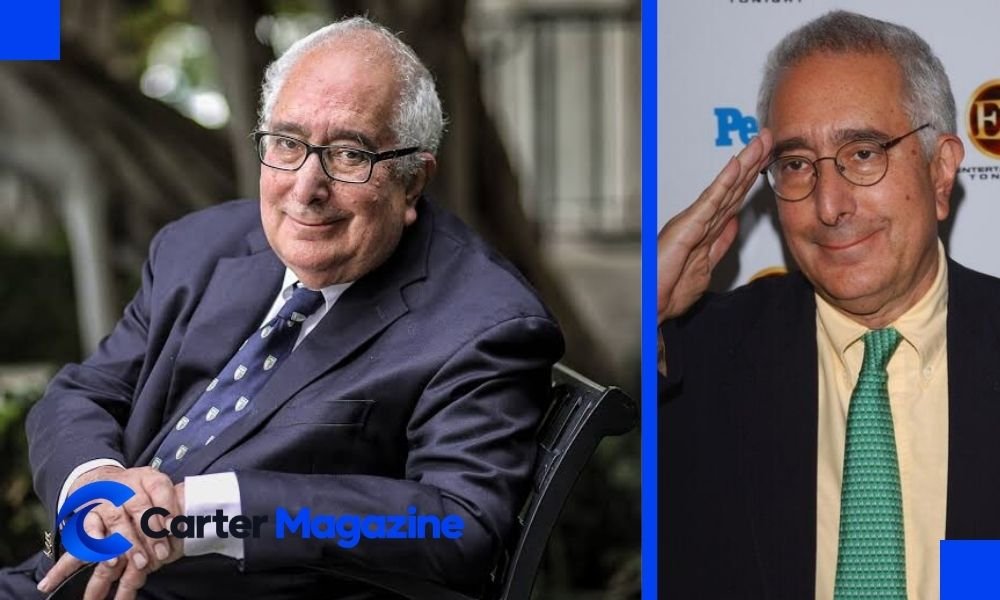
Ben Stein speech writer is a search that points to one of the lesser-known chapters in the unusual career of Ben Stein. Before millions knew him for his famously monotone teacher in Ferris Bueller’s Day Off or the game show Win Ben Stein’s Money, Benjamin Jeremy Stein worked in Washington and became a speechwriter during the administrations of Presidents Richard Nixon and Gerald Ford. The Nixon Foundation also identifies Stein as a former Nixon speechwriter.
His career is difficult to fit into one box. Stein trained as a lawyer, worked in government, wrote about economics, taught law, published books and columns, acted in movies and television, and became an Emmy-winning game-show personality. His time as a presidential speechwriter was an early chapter in that much larger story.
Ben Stein Quick Bio
| Detail | Information |
|---|---|
| Full Name | Benjamin Jeremy Stein |
| Born | November 25, 1944 |
| Age in 2026 | 81 |
| Birthplace | Washington, D.C. |
| Profession | Writer, lawyer, actor, commentator, educator |
| Education | Columbia University; Yale Law School |
| White House Work | Speechwriter |
| Presidents Served | Richard Nixon and Gerald Ford |
| Famous Film | Ferris Bueller’s Day Off |
| Famous TV Show | Win Ben Stein’s Money |
| Father | Herbert Stein |
| Wife | Alexandra Denman |
| Son | Tom Stein |
| Net Worth | Exact personal wealth is not publicly audited |
Who Is Ben Stein?
Ben Stein is one of those people whose résumé can sound as if it belongs to several different people.
He is a lawyer.
He has written extensively about economics and finance.
He worked in government.
He became a university teacher.
Then he became an actor and television personality.
His own official site describes him as a speechwriter for Presidents Nixon and Ford, a longtime columnist and an Emmy-winning television host.
For younger viewers, however, none of those accomplishments may be the first thing that comes to mind.
They may simply remember one word:
“Bueller?”
That contrast is what makes Stein’s biography so interesting.
Ben Stein Was Born Into a World of Economics and Public Policy
Benjamin Jeremy Stein was born on November 25, 1944, in Washington, D.C.
His father, Herbert Stein, was a respected economist who later chaired the Council of Economic Advisers during the Nixon and Ford years.
Growing up around economics and government gave the younger Stein early exposure to ideas that would become important throughout his own career.
Yet he did not simply follow his father’s exact path.
Ben combined economics with law, writing, politics and eventually entertainment.
That unusual mixture started with an impressive education.
Where Did Ben Stein Go to College?
Stein attended Columbia University, where he studied economics.
He then went to Yale Law School, graduating in 1970.
Law school provided a foundation for several parts of his later career.
Legal training teaches people to analyze complicated information, identify the strongest argument and communicate it clearly.
Those skills are useful in a courtroom.
They are also useful when writing for a president.
Stein’s career soon moved toward Washington, where words could carry national consequences.
Ben Stein’s Early Legal Career
Before becoming famous for political writing, Stein worked in law.
His professional experience included work connected with the Federal Trade Commission, and he also practiced law.
But writing increasingly became central to his career.
Stein had the combination needed for political communication: knowledge of economics, legal training and the ability to turn complicated ideas into understandable language.
That eventually brought him into the Nixon administration.
It was an environment filled with experienced writers and advisers.
The Nixon White House had a substantial research and writing operation involving figures such as Raymond Price, William Safire, Pat Buchanan, Lee Huebner and others. The Nixon Foundation’s historical material describes how writers worked together on presidential speeches and policy messages.
Stein entered that broader world later in Nixon’s presidency.
Was Ben Stein Really a Speechwriter for Richard Nixon?
Yes.
This is not simply a claim repeated by celebrity websites.
The Richard Nixon Foundation itself repeatedly identifies Ben Stein as a former Nixon speechwriter. For example, its coverage of Pat Nixon’s centennial celebration introduced Stein as an actor and former Nixon speechwriter.
Another Nixon Foundation article discussing Stein’s comments about Nixon again identifies him as a Nixon speechwriter.
His own professional biography likewise describes him as having written speeches for Presidents Nixon and Ford.
So the basic answer is clear:
Yes, Ben Stein genuinely worked as a presidential speechwriter.
It was not a fictional role or a title created after he became famous.
What Does a Presidential Speechwriter Actually Do?
The title sounds simple.
The job is not.
A president may give speeches about the economy, foreign affairs, legislation, elections, national tragedies and major policy announcements.
The president cannot personally begin every speech with a blank page.
A White House writing operation helps collect ideas, policy information, arguments and suggested language.
Then drafts are created and revised.
A fascinating description from a former Nixon writer compared speechwriting with craftsmanship. Different pieces—policy statements, introductions, jokes, arguments and material from experts—have to be assembled into something the president can actually deliver.
And the final words still have to sound like the president.
That is crucial.
A speechwriter is not writing a personal essay.
The audience should hear the president’s voice, not the writer’s.
Ben Stein Was Not Nixon’s Only Speechwriter
This point is especially important.
Sometimes online articles describe Stein as though he single-handedly wrote Richard Nixon’s speeches.
That would be misleading.
Nixon had an established team of writers and advisers.
The Nixon Foundation identifies Raymond K. Price as White House Director of Speechwriting from 1970 to 1973. It also documents major roles for writers including Pat Buchanan, William Gavin, Kenneth Khachigian, Lee Huebner and William Safire.
Nixon himself was also deeply involved in the process.
Historical accounts describe him providing detailed instructions about tone, arguments, current events and how he wanted political messages presented.
So Stein should be understood as one contributor within a larger White House writing operation, particularly during the later Nixon period.
That is more accurate than presenting him as “the man who wrote Nixon’s speeches.”
Did Ben Stein Write Nixon’s Famous “I Am Not a Crook” Line?
There is no good reason to credit Ben Stein with that famous statement.
Nixon made the remark during a televised question-and-answer session with newspaper editors in Orlando, Florida, in November 1973.
It was not simply a famous prepared presidential address credited to Stein.
This distinction matters because famous quotes are often incorrectly attached to presidential speechwriters.
Once someone learns that Stein worked for Nixon, it is tempting to assume every memorable Nixon line came from him.
Presidential communication does not work that way.
Some remarks are scripted.
Others are heavily revised by presidents.
Some come from different writers.
And others are spontaneous responses.
So the safe answer is that Stein served on Nixon’s writing staff, but famous Nixon quotations should not automatically be attributed to him.
Did Ben Stein Write Nixon’s Resignation Speech?
This is another common misunderstanding.
Richard Nixon announced his resignation on August 8, 1974.
But the best historical evidence does not support describing Ben Stein as the principal author of that famous address.
Nixon’s speechwriting operation involved several senior writers, and different people worked on different major addresses.
The Nixon Foundation’s historical material particularly emphasizes figures such as Ray Price in connection with some of Nixon’s most important speeches. It notes that Price became known for drafting both Nixon’s first and last speeches as president.
So saying “Ben Stein wrote Nixon’s resignation speech” would oversimplify—or misstate—the historical record.
Stein worked for Nixon.
That does not mean every major Nixon speech was his work.
Ben Stein and Watergate
Because Stein worked in the Nixon White House during the Watergate era, the two subjects naturally appear together in searches.
Watergate eventually destroyed Nixon’s presidency.
But Stein is remembered as a speechwriter and writer rather than as one of the central figures in the break-in or the criminal cases that followed.
His White House employment placed him close to an extraordinary moment in American political history.
The scandal began with the June 1972 break-in at Democratic National Committee headquarters in the Watergate complex.
Investigations then uncovered a much larger political and legal crisis.
By August 1974, Nixon had lost crucial political support and resigned rather than face the likely outcome of impeachment proceedings.
Stein’s government career therefore unfolded during one of the most turbulent periods ever experienced by a modern White House.
Stein Has Defended Nixon’s Legacy
Ben Stein’s relationship with Nixon did not end when Nixon left office.
Years later, Stein continued speaking publicly about the former president.
The Nixon Foundation has hosted Stein at events and documented his remarks defending aspects of Nixon’s record, including Nixon’s support for Israel during the 1973 Yom Kippur War.
This is an area where facts and personal interpretation need to be separated.
It is factual that Stein worked for Nixon.
It is also factual that Stein has publicly defended Nixon’s legacy.
But those defenses represent Stein’s own political and historical judgments, not a neutral consensus about the Nixon presidency.
Watergate and Nixon’s broader legacy remain subjects of extensive historical debate.
Understanding Stein’s position therefore requires knowing that he was not merely a distant historian studying Nixon.
He had worked for the man.
Ben Stein Also Worked for Gerald Ford
Stein’s White House writing career continued into the administration of Gerald Ford.
Ford became president on August 9, 1974, immediately after Nixon resigned.
Stein’s own biography describes him as a speechwriter for both Nixon and Ford.
That experience is notable because the two administrations faced very different circumstances.
Nixon’s final period was dominated by Watergate and political crisis.
Ford entered office trying to restore stability and public confidence.
A presidential writer working through that transition had to adjust to a different president, voice and political environment.
The underlying skill remained the same:
Writing words that sounded natural coming from someone else.
Why Speechwriting Helped Stein’s Later Career
Consider what a presidential speechwriter has to do.
Understand complicated information quickly.
Find the central argument.
Remove unnecessary language.
Explain ideas to ordinary people.
Write memorable lines.
Work under deadline.
Accept revisions without becoming attached to every sentence.
Those skills transfer easily into other careers.
Stein later became a columnist and author.
He wrote about economics and personal finance.
He taught.
He appeared as a commentator.
Then, surprisingly, he became a comic actor.
Even there, timing and language mattered.
His career changed dramatically, but communication remained at the center of almost everything he did.
From Washington to Hollywood
The jump from White House speechwriter to Hollywood actor sounds almost impossible.
Yet that is exactly what makes Stein memorable.
After his government work, he continued writing and teaching. Eventually, he began appearing on television and in films.
His unusual voice helped.
Stein’s slow, flat, unmistakably monotone delivery could make even an ordinary sentence funny.
Hollywood noticed.
Then came a tiny role that became far more famous than anyone expected.
Ferris Bueller’s Day Off Changed His Public Image
In 1986, Stein appeared in John Hughes’s Ferris Bueller’s Day Off as an economics teacher.
The role was small.
But it became iconic.
Standing in front of a bored classroom, Stein delivered a painfully dry economics lesson while repeatedly trying to get students to respond.
His monotone delivery was perfect.
The joke worked partly because Stein actually understood economics.
He was not merely an actor pretending to know what he was talking about.
His background made the scene feel strangely authentic.
The role transformed his public identity.
Millions of viewers who had no idea he once worked in the White House suddenly recognized his face and voice.
“Bueller? Bueller?” Became Part of Pop Culture
The classroom sequence became one of the most remembered scenes in the film.
Stein’s teacher keeps calling for Ferris.
No answer.
The repeated “Bueller?” became cultural shorthand for silence or someone failing to respond.
The role demonstrates something funny about fame.
Stein had graduated from Yale Law School.
Worked in Washington.
Written for presidents.
Taught law and economics.
Written books and columns.
Yet millions of people knew him because he said one name in a monotone voice.
That could have been the end of his entertainment career.
Instead, Hollywood kept calling.
Ben Stein Became a Familiar Character Actor
After Ferris Bueller’s Day Off, Stein appeared in many movies and television programs.
His deadpan personality became his signature.
Rather than trying to transform into wildly different characters, productions often used the quality audiences already loved about him.
That recognizable delivery appeared in comedies, television shows, commercials and animated projects.
His official biography highlights appearances in Ferris Bueller’s Day Off, The Wonder Years and The Mask, among many other credits.
But another television project would make his name even more recognizable.
This time, his intelligence was not merely part of the joke.
It was the whole concept.
Win Ben Stein’s Money
In 1997, Comedy Central launched Win Ben Stein’s Money.
The idea was clever.
Contestants competed against Stein in a quiz show and attempted to “win” his money.
Stein’s combination of intelligence and deadpan humor made him ideal for the format.
The program also helped launch the television career of Jimmy Kimmel, who served as a co-host early in the show’s run.
Win Ben Stein’s Money became successful and won Daytime Emmy recognition.
Stein’s official biography describes him as an Emmy-winning host.
Think about the career journey involved.
A man who once wrote words for a president was now using his knowledge and personality as the center of a comedy game show.
And both jobs somehow made sense.
Ben Stein the Economist and Financial Writer
Entertainment never completely replaced Stein’s interest in economics.
He has written extensively about money, investing and retirement.
His father, Herbert Stein, had been a major economist and government adviser, so economics was part of the family’s intellectual world.
Ben later used his own background to write books aimed at ordinary investors.
His official website highlights his financial writing and describes him as a longtime commentator on economics and public policy.
That combination gave him an unusual public identity.
He could discuss markets and government policy seriously.
Then appear in a comedy.
Then write a personal-finance book.
Then return to television.
Very few public figures have moved between those worlds so freely.
Ben Stein as a Teacher
Stein has also taught law and economics.
His academic work is another reminder that the famous movie classroom was an exaggerated version of something not completely foreign to him.
He actually had teaching experience.
Of course, real students probably hoped his classes were more exciting than the fictional lesson in Ferris Bueller’s Day Off.
His official biography has described him as a professor of law and economics at Pepperdine University.
Teaching, writing and speechwriting share an important skill.
You have to make ideas understandable.
That thread runs through almost every part of Stein’s career.
Ben Stein’s Family
Stein married Alexandra Denman in 1968.
Their relationship has an unusual history: they divorced in 1974 and later remarried in 1977.
They have a son, Tom, whom they adopted.
Stein has generally been much more publicly associated with his own career than with turning his family into celebrity entertainment.
His father, Herbert Stein, remains particularly relevant to understanding Ben’s intellectual background.
Herbert served as chairman of the Council of Economic Advisers under Nixon and Ford.
So father and son both became connected with the same presidential era, although in different professional roles.
How Old Is Ben Stein in 2026?
Ben Stein was born on November 25, 1944.
As of September 2026, he is 81 years old. He will turn 82 in November.
His career now spans more than half a century.
That longevity helps explain why different generations know him for completely different things.
Someone interested in Nixon may know him as a former White House writer.
A finance reader may know his columns and books.
A movie fan remembers Ferris Bueller’s Day Off.
A 1990s television viewer may immediately think of Win Ben Stein’s Money.
They are all talking about the same person.
What Is Ben Stein’s Net Worth?
Ben Stein’s exact current net worth is not publicly audited.
Various celebrity-finance websites publish estimates, sometimes around the tens-of-millions-of-dollars level, but those figures should not be confused with verified financial disclosures.
His career has certainly included numerous income sources.
Legal work.
Writing.
Books.
Teaching.
Movies.
Television.
Commercials.
Speaking engagements.
Financial commentary.
But knowing that someone has had a long and successful career is different from knowing exactly how much money they possess.
Assets, investments, taxes, property and liabilities all affect personal net worth.
Without complete financial records, an exact number remains an estimate.
Was Ben Stein a Republican Speechwriter?
Stein worked for two Republican presidents: Richard Nixon and Gerald Ford.
That is a straightforward historical fact.
He has also spent decades expressing his own political views publicly as a commentator.
Those later opinions should be distinguished from the basic biographical question of what he did in the White House.
His job was to help an administration communicate.
His later political commentary represents his own positions.
And the historical merits of Nixon, Ford or any policy Stein has discussed are separate questions from whether he served as a speechwriter.
He did.
How Important Was Ben Stein in the Nixon White House?
Stein’s White House experience is significant to his biography, but it should be kept in proportion.
He was not Nixon’s sole speechwriter.
Nor was he the head of the White House writing operation throughout the presidency.
The Nixon Foundation’s history of the speechwriting team highlights several major figures, particularly Ray Price, who directed speechwriting from 1970 to 1973, alongside writers including Pat Buchanan, William Gavin, Ken Khachigian and William Safire.
Stein joined the speechwriting world during the later Nixon period and subsequently worked for Ford.
So his role was genuine, but presidential speeches were collaborative products.
That nuance makes the history more accurate, not less interesting.
Why People Still Search “Ben Stein Speech Writer”
For many people, discovering Stein’s White House past produces a genuine surprise.
The movie teacher was a presidential speechwriter?
Yes.
The game-show host went to Yale Law School?
Yes.
The comedy actor wrote about economics?
Yes.
That is why “Ben Stein speech writer” remains such an interesting search phrase.
It reveals a career hidden behind a familiar face.
His Hollywood persona can make him seem like someone who entered public life through comedy.
In reality, Washington came first.
The entertainment career arrived later.
Final Thoughts
The story behind Ben Stein speech writer is much more interesting than a simple job title.
Before Ferris Bueller’s Day Off, before Win Ben Stein’s Money, and before his familiar television appearances, Stein had already built a serious career in law, economics and government.
He graduated from Yale Law School in 1970 and eventually entered White House speechwriting.
Historical material from the Nixon Foundation repeatedly identifies Stein as a former Nixon speechwriter, while Stein’s professional biography says he wrote for both Richard Nixon and Gerald Ford.
But he was part of a team.
Nixon’s speechwriting operation included major figures such as Ray Price, Pat Buchanan, William Safire, William Gavin, Lee Huebner and Ken Khachigian. Nixon himself was also heavily involved in shaping his rhetoric.
That makes Stein’s story more precise.
He was not secretly responsible for every famous Nixon line.
He was one writer working inside a complicated presidential communication system during an extraordinary period in American history.
Then his career took a turn almost nobody could have predicted.
The former White House writer went to Hollywood.
His monotone voice became comedy gold.
A tiny classroom scene made him famous.
A television quiz show won him an Emmy.
Yet he never completely left writing, economics or public commentary behind.
That is what makes Ben Stein unusual.
Most people would consider presidential speechwriting a complete career.
For him, it was only one chapter.
FAQs About Ben Stein as a Speech Writer
Was Ben Stein really a speechwriter for Richard Nixon?
Yes. The Richard Nixon Foundation identifies Ben Stein as a former Nixon speechwriter, and Stein’s professional biography also lists his presidential speechwriting experience.
Did Ben Stein write speeches for Gerald Ford?
Yes. Stein’s professional biography states that he worked as a speechwriter for both Presidents Richard Nixon and Gerald Ford.
Did Ben Stein write all of Nixon’s speeches?
No. Nixon employed multiple speechwriters and advisers. The White House writing operation included Ray Price, Pat Buchanan, William Safire, William Gavin, Lee Huebner, Ken Khachigian and others.
Did Ben Stein write Nixon’s resignation speech?
He should not be credited as the principal writer of Nixon’s resignation address. Nixon Foundation historical material particularly identifies Ray Price with drafting Nixon’s last speech as president.
Was Ben Stein involved in Watergate?
Stein worked in the Nixon White House during the Watergate period, but he is historically identified as a speechwriter rather than as one of the central participants in the Watergate crimes or prosecutions.
What movie made Ben Stein famous?
His memorable appearance as an economics teacher in the 1986 comedy Ferris Bueller’s Day Off became one of his best-known film roles.
What is Ben Stein’s famous line?
His repeated “Bueller?” from Ferris Bueller’s Day Off became one of the most recognizable moments associated with his acting career.
What did Ben Stein study?
Stein studied economics at Columbia University before attending Yale Law School, where he graduated in 1970.
How old is Ben Stein?
Born November 25, 1944, Ben Stein is 81 years old as of September 2026.
Is Ben Stein still known for economics?
Yes. Economics and personal finance have remained important parts of his writing and public speaking alongside his entertainment career. His official biography continues to emphasize his work in economics, finance, law and public policy.
For more television, cast and entertainment stories, visit Carter Magazine.
