

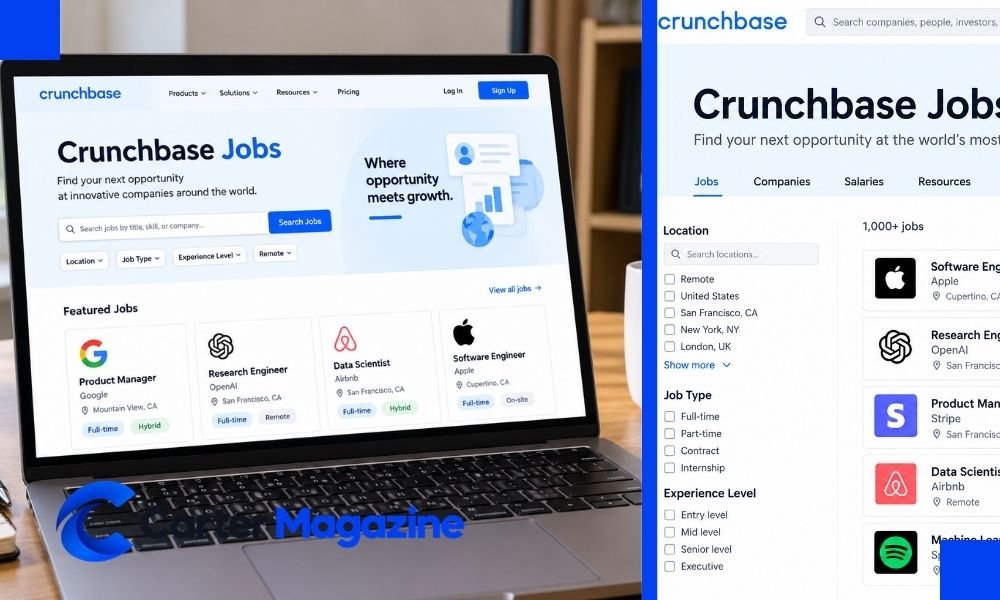
Crunchbase jobs can mean two different things: jobs working directly for Crunchbase, or job opportunities discovered by using Crunchbase to find companies that are actively hiring. Both are useful. Crunchbase maintains an official careers page for its own vacancies, while its company database includes an “Actively Hiring” feature that can help job seekers identify businesses with open positions.
This distinction is worth understanding because Crunchbase is not simply a traditional job board. Its main strength is private-company intelligence: users can research businesses, industries, funding, growth signals and people. Crunchbase itself says its platform is powered by live company data, AI and market activity from more than 80 million users.
Quick Overview of Crunchbase Jobs
| Detail | Information |
|---|---|
| Company | Crunchbase |
| Industry | Private-company intelligence and business data |
| Headquarters | San Francisco, California |
| Company Size Shown on Crunchbase | 101–250 employees |
| CEO | Jager McConnell |
| Work Style | Remote-first |
| U.S. Remote Availability | 16 states, according to careers page |
| Main Job Areas | Engineering, product, data, sales, marketing, customer success and operations |
| Official Vacancies | Listed on Crunchbase Careers |
| Can Crunchbase Find Other Companies Hiring? | Yes |
| Actively Hiring Filter | Available within Crunchbase search |
| Hiring Data Partner | Jobbio |
| Home-Office Allowance | $1,000, according to careers page |
| Learning & Development | $3,000 stipend |
| Company Offsites | Twice yearly |
What Is Crunchbase?
Crunchbase is a business-information platform focused heavily on private companies, startups, investors, funding activity and market intelligence.
Its database lets users research organizations and people, explore industries, examine funding information and follow signals that may suggest a company is growing.
That explains why Crunchbase can be useful for job hunting even though it is not primarily a conventional employment website.
Imagine you want a software job at a growing artificial-intelligence startup.
A normal job site might show you advertisements for “Software Engineer.”
Crunchbase can help you approach the search from another direction.
Which AI companies recently raised money?
Which are growing?
Which are actively hiring?
Where are they located?
Who works there?
Those questions can help you build a more targeted job search.
Are There Jobs at Crunchbase Itself?
Yes.
Crunchbase has an official careers section where it publishes current vacancies.
The company says it is looking for mission-focused people who are interested in taking on large challenges. Its careers page groups openings under its teams and open-positions section.
Vacancies naturally change over time.
That means an article listing individual job titles can become outdated quickly.
The better approach is to check the official page when you are ready to apply:
View current Crunchbase job openings
If a role disappears from that page, do not assume an old third-party listing is still open.
Always verify the vacancy before preparing an application.
What Types of Crunchbase Jobs Can You Find?
The exact openings change, but Crunchbase employs people across the areas needed to build and operate a large business-data platform.
Its own company profile currently shows 140 employee profiles, including positions in engineering, product, customer success, marketing and other functions.
For example, its current employee profiles include roles connected with engineering and data, product management, customer experience and growth marketing.
That gives potential applicants a useful idea of the skills Crunchbase needs.
Technical candidates may look toward software, data and machine-learning roles.
Business-focused applicants may find opportunities in sales, marketing, customer success, finance or operations.
Product specialists can look for roles connecting customer needs with Crunchbase’s datasets and software.
Is Crunchbase Remote?
Crunchbase describes itself as a remote-first company.
However, “remote-first” does not mean “work from absolutely anywhere in the world.”
Its current careers page says employees can live in any of the 16 U.S. states where Crunchbase supports remote work.
That restriction is important.
Someone living outside those approved locations should not assume that a job marked remote is automatically available to them.
Employment law, payroll, taxation and company policies can all affect where remote employees may work.
Read the location requirements on the individual vacancy before applying.
Does Crunchbase Still Have In-Person Events?
Yes.
A remote-first company does not necessarily mean employees never meet.
Crunchbase says it holds biannual company offsites, meaning company gatherings generally happen twice each year. Employees living near one another can also meet through collaboration days and other events.
This gives the company a hybrid kind of culture.
Day-to-day work may happen remotely.
Teams still have opportunities to meet face to face.
For some workers, that can offer a useful middle ground between a traditional office and a completely disconnected remote company.
Crunchbase Employee Benefits
Benefits can be almost as important as salary when choosing a job.
Crunchbase currently lists medical, vision and dental coverage among its health benefits. It also mentions 401(k) and Roth plans, mental-health days and 14 weeks of fully paid leave of absence.
There is another interesting policy.
Thursday is listed as a no-meeting day.
Anyone who has spent an entire workday jumping from video call to video call can probably understand the appeal.
A meeting-free day can give employees uninterrupted time for coding, research, writing, planning and other focused work.
Crunchbase Gives Employees a Home-Office Allowance
Remote work can save commuting time, but setting up a good workspace costs money.
Crunchbase says employees receive a $1,000 allowance for building a home office.
The company also lists a monthly internet stipend and quarterly engagement stipend.
Those benefits fit its remote-first model.
A company cannot tell employees to work remotely and then ignore the tools they need at home.
A desk, monitor, chair and reliable internet connection can make a meaningful difference.
The exact rules and eligibility for each benefit should still be checked during the hiring process.
There Is a $3,000 Learning and Development Stipend
One benefit that may interest ambitious applicants is Crunchbase’s learning budget.
Its careers page currently advertises a $3,000 learning and development stipend.
That could potentially support professional development, although candidates should check the company’s exact reimbursement rules.
Why does this matter?
Technology changes quickly.
AI changes quickly.
Data tools change quickly.
Someone working in software, analytics, marketing or product management cannot assume the skills they learned five years ago will always be enough.
Employers that invest in learning can help workers keep developing.
What Does Crunchbase Look for in Employees?
Crunchbase publicly describes five main company values.
They are centered on customers, bold thinking, teamwork, excellence and doing what is right.
These values are useful when preparing an application.
Do not simply write:
“I am hardworking.”
Almost everyone writes that.
Instead, demonstrate the qualities with evidence.
If you improved a customer process, explain what changed.
If you took ownership of a difficult project, describe the problem.
If you worked across multiple teams, explain how.
If AI helped you improve a workflow, show the result.
Specific examples are much stronger than generic adjectives.
AI Is Clearly Important at Crunchbase
Crunchbase’s careers page explicitly mentions using AI to raise the bar as part of its “Demand Excellence” value.
The company’s own profile also categorizes Crunchbase within areas including artificial intelligence, big data, databases, market research and software.
That means AI familiarity can be useful even outside pure machine-learning jobs.
A marketer might use AI differently from an engineer.
A salesperson might use it for research.
A product manager might use it for analysis and prototyping.
The important thing is understanding how AI can improve actual work rather than simply adding “AI” to a résumé because it sounds modern.
How to Apply for Crunchbase Jobs
The safest starting point is Crunchbase’s official careers page.
Review the live openings and select a position that genuinely fits your experience.
Then read the complete job description.
Pay attention to location.
Experience.
Technical requirements.
Responsibilities.
And required versus preferred skills.
Your résumé should then emphasize the experience most relevant to that particular job.
One generic résumé sent to 100 companies is usually less persuasive than a carefully adjusted résumé showing why your experience fits one role.
Research Crunchbase Before Your Interview
There is a funny advantage when applying to Crunchbase.
You can use Crunchbase to research Crunchbase.
Its company profile currently describes the business as a predictive private-company intelligence solution using live company data, AI and market activity. The profile places the company in San Francisco and shows a 101–250 employee range.
Understanding the product matters during an interview.
You should be able to explain, in simple language, what Crunchbase does and who might use it.
Founders may use the platform to research investors.
Investors can research companies.
Sales teams can identify prospects.
Analysts can study markets.
Job seekers can research employers.
Showing that you understand the customer is much stronger than saying, “I just need a remote job.”
Crunchbase Can Also Help You Find Jobs Elsewhere
This is where the phrase “Crunchbase jobs” becomes much more interesting.
Crunchbase can help identify companies that are hiring.
Its Knowledge Center explains that the platform has Actively Hiring data. If a company has one or more open positions, an actively hiring badge can appear in the company’s About section.
Crunchbase says this data is powered through a partnership with Jobbio.
Users can also search specifically for companies with active vacancies.
So instead of searching only for job titles, you can search for employers first.
How the “Actively Hiring” Filter Works
Crunchbase says users can select the Actively Hiring filter within the Overview section of search.
That filters toward companies with one or more active job postings.
On an individual company profile, an “Actively Hiring – View All Jobs” badge can lead to available positions.
There is also an alerts angle.
Crunchbase says users can save a company profile or search and receive updates about company activity, including hiring-related changes.
This can turn Crunchbase from a one-time research tool into an ongoing job-discovery system.
A Smarter Way to Search for Startup Jobs
Suppose you want to work at an AI startup.
Typing “AI jobs” into a normal search engine could return thousands of mixed results.
With company intelligence, you can narrow the problem.
Start with the industry.
Then location.
Then company size.
Then funding or growth characteristics.
Then actively hiring status.
Now your target is not “every AI company.”
It might be “growing AI companies of a certain size that are currently hiring and fit my location requirements.”
That is much more manageable.
Why Funding Can Matter to Job Seekers
Startup funding does not guarantee a company will hire.
And raising money definitely does not guarantee the company will succeed.
But funding can still be a useful signal.
A startup that has just raised capital may use some of that money for hiring engineers, salespeople, marketers or other specialists.
Crunchbase is particularly well known for funding and private-company information.
That means job seekers can potentially combine funding research with hiring signals.
The key is not to assume:
“Raised money = safe job.”
Instead think:
“Raised money = company worth researching.”
Then check the actual vacancies, company direction and role.
Search Companies Before Searching Vacancies
Most applicants do this:
Find job → research company → apply.
Crunchbase makes another workflow possible:
Find interesting company → research growth → check hiring → apply.
That small change can be powerful.
You may discover businesses you had never heard of.
Big companies receive huge numbers of applications because everyone knows their names.
Smaller private companies can be harder to discover.
A company database helps uncover them.
That is particularly useful in technology, where promising startups can grow rapidly before becoming household names.
Crunchbase Search Has Detailed Company Filters
Crunchbase Pro supports advanced company search.
Its search interface includes filters for areas such as description keywords, headquarters location, industry, employee count and founding date.
Those filters can help job seekers answer very specific questions.
Maybe you want a startup rather than a huge corporation.
Filter by employee count.
Maybe you only want fintech.
Filter by industry.
Maybe you need companies in a certain region.
Filter by headquarters location.
The more clearly you know what you want, the more useful these filters become.
Can You Use Crunchbase to Find Remote Jobs?
Indirectly, yes.
Crunchbase can help you identify companies and active hiring signals, but you still need to check the actual vacancy for its remote-work rules.
“Remote” is not one universal category.
A company may allow remote work only within the United States.
Another may require a particular state.
Another may hire internationally.
Another may call itself remote but require occasional office visits.
Crunchbase itself is a perfect example: its careers page calls the company remote-first while stating that remote employees can live in 16 supported U.S. states.
Always read the individual job description.
Can International Applicants Apply to Crunchbase?
This depends on the specific position and its location requirements.
The current careers page describes Crunchbase’s remote-first arrangement in terms of 16 U.S. states.
Therefore, an international applicant should not assume that every remote Crunchbase position can be performed from another country.
Check each listing.
If it requires residence or work authorization in a supported U.S. location, treat that requirement seriously.
Do not hide your location during the application process.
A location mismatch discovered later wastes your time and the employer’s time.
How to Make Your Crunchbase Job Application Stronger
A good application should answer one question quickly:
Why you?
Your résumé should make that easy to see.
For a data position, show data projects and measurable results.
For engineering, demonstrate systems you built and problems you solved.
For marketing, show growth, campaigns, conversion improvements or audience results.
For sales, show pipeline or revenue achievements when appropriate.
For customer success, demonstrate retention, satisfaction or process improvements.
Numbers can make examples stronger.
“Improved a process” is vague.
“Reduced processing time by 30%” tells a story.
Do Not Ignore the Company’s Product
One common job-application mistake is researching the vacancy but not the product.
Try Crunchbase.
Explore company profiles.
Understand what information is available.
Look at search.
Read the product descriptions.
Crunchbase’s welcome page explicitly presents use cases including sales prospecting, finding companies to invest in, finding investors, finding a next job, product development and market research.
If an interviewer asks why you want to work there, knowing these use cases gives you something meaningful to discuss.
Be Careful With Fake Crunchbase Job Offers
Well-known technology companies can be impersonated by scammers.
A fake recruiter may promise a job without a proper interview.
They may ask for money.
They may request sensitive personal information too early.
They may use an email address that only looks similar to the real company.
The simplest protection is to compare the supposed vacancy with Crunchbase’s official careers page.
Official Crunchbase Careers page
Never pay someone simply to “unlock” a job offer.
And be cautious if a recruiter creates artificial urgency around money or sensitive information.
Is Crunchbase Free for Job Searching?
Crunchbase offers registration and paid product options, while some information can be accessed without the full paid feature set. Its current welcome experience includes options to register, start a free trial or speak with sales.
Advanced research capabilities may depend on the plan.
Whether a paid plan makes sense for a job seeker depends on how intensively they intend to use the platform.
Someone applying to one company may not need sophisticated research.
Someone building a target list of hundreds of startups may find deeper filtering more useful.
The important thing is to decide based on your actual workflow rather than assuming paying automatically improves your chance of getting hired.
Crunchbase Is Not Just for Job Seekers
The platform serves several audiences.
Investors research private companies.
Founders look for investors.
Sales teams identify prospects.
Researchers analyze markets.
Product teams study industries.
And job seekers can use company information to discover employers.
That variety explains why Crunchbase looks different from a normal careers website.
The job-search feature is part of a larger company-intelligence system.
That can make it especially useful for people targeting startups or private technology companies.
Is Crunchbase a Good Place to Work?
There is no universal answer because different employees want different things from a workplace.
What can be said factually is that Crunchbase currently promotes a remote-first culture, twice-yearly company offsites, health coverage, retirement plans, a $1,000 home-office allowance, internet support, a $3,000 learning-and-development stipend, mental-health days and Thursday no-meeting days.
Those policies may appeal to people who value remote work and professional development.
Candidates should still ask questions during interviews.
How is performance measured?
How often does the team meet?
What does career progression look like?
How much collaboration happens across time zones?
Benefits look nice on a careers page, but day-to-day expectations matter just as much.
Crunchbase Jobs in 2026: What Matters Most
The phrase Crunchbase jobs really describes two useful paths.
The first is straightforward.
You want to work for Crunchbase.
In that case, use its official careers page and review the current openings.
The second path is broader.
You want to use Crunchbase to discover jobs at other companies.
That may actually be the more powerful use.
Crunchbase’s Actively Hiring data can help identify businesses with open roles, while company filters can narrow your search by industry, size, location and other characteristics.
Instead of waiting for the perfect vacancy to appear in front of you, you can research the companies where you would actually like to work.
Final Thoughts
Crunchbase jobs are worth understanding because Crunchbase can play two roles in your career search.
First, Crunchbase is itself an employer.
Its official careers page currently describes a remote-first culture operating across 16 supported U.S. states. Benefits listed there include health coverage, retirement plans, 14 weeks of fully paid leave of absence, mental-health days, a $1,000 home-office allowance and a $3,000 learning-and-development stipend.
Second, Crunchbase can help you find other employers.
Its Actively Hiring feature identifies companies with one or more open positions, and users can search for hiring companies or view available jobs from company profiles. Crunchbase says this hiring data is powered by Jobbio.
That second use can change the way you look for work.
Do not search only for vacancies.
Search for promising companies.
Research them.
Watch their growth.
See who is hiring.
Then apply where your skills genuinely fit.
For startup and technology job seekers especially, that can turn Crunchbase from a company database into a useful career-research tool.
FAQs About Crunchbase Jobs
Where can I find official Crunchbase jobs?
Use Crunchbase Careers. The page contains the company’s teams and current open positions.
Is Crunchbase a remote company?
Crunchbase describes itself as remote-first. Its current careers page says employees can live in any of 16 U.S. states where it supports remote work.
What kinds of jobs does Crunchbase offer?
Openings vary, but the company employs people across engineering, data, product, marketing, customer success and other business functions. Its company profile currently shows 140 employee profiles across multiple departments.
Can I use Crunchbase to find jobs at other companies?
Yes. Crunchbase has Actively Hiring data that can identify companies with one or more active job openings.
What does “Actively Hiring” mean on Crunchbase?
Crunchbase says the badge indicates that a company has one or more open positions available. Its hiring data is powered through its partnership with Jobbio.
Can Crunchbase help me find startup jobs?
Yes. Its company database and filters can be useful for researching startups by industry, location, size and other characteristics, then checking whether those businesses are hiring.
Does Crunchbase offer employee benefits?
Its careers page currently lists medical, vision and dental coverage, retirement plans, paid leave, mental-health days, a home-office allowance, internet stipend and professional-development benefits.
Does Crunchbase give employees money for a home office?
Yes. Its current careers page lists a $1,000 home-office allowance, alongside a monthly internet stipend.
Can I work for Crunchbase from another country?
Do not assume every remote position is internationally available. Crunchbase currently describes its remote-first program as operating in 16 supported U.S. states, so applicants should check the location rules of each individual vacancy.
Is Crunchbase only a job-search website?
No. Crunchbase is primarily a private-company intelligence platform. Its use cases include company and investor research, sales prospecting, market research and job discovery.
For more television, cast and entertainment stories, visit Carter Magazine.
