

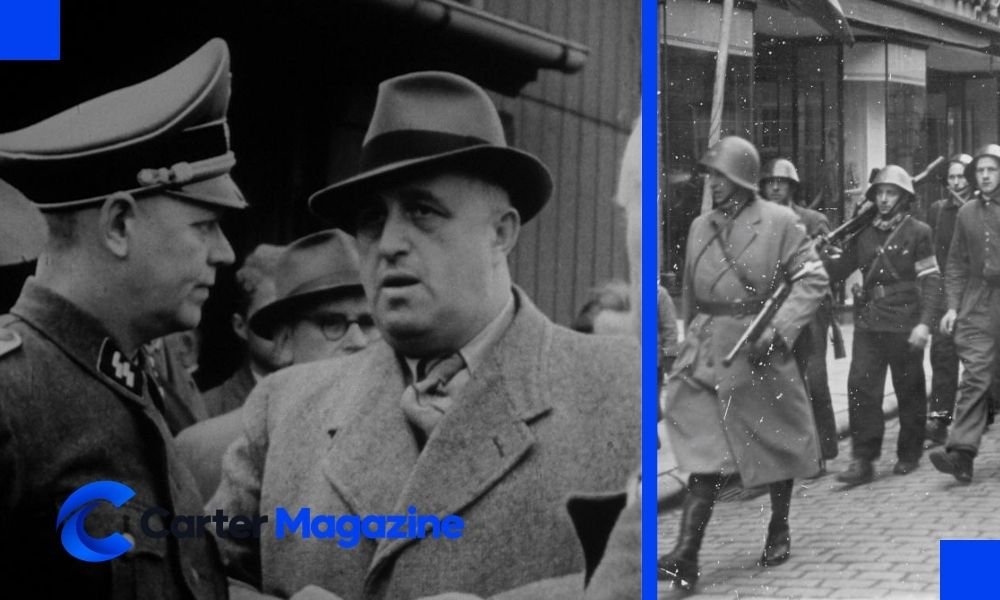
Fascisterne is a Danish word that means “the fascists” in English. It is the definite plural form of fascist, meaning people who support fascism or fascist political ideas. The word is strongly connected with the history of fascism in Europe, particularly Benito Mussolini’s dictatorship in Italy and related authoritarian movements that appeared during the period between the First and Second World Wars. In Denmark, the word can also appear when discussing Danish fascist and Nazi movements of the 1930s and the German occupation from 1940 to 1945. The Danish dictionary defines a fascist as a supporter of fascism and also records a broader modern use for strongly authoritarian and ultranationalist political attitudes.
Fascisterne Quick Overview
| Detail | Information |
|---|---|
| Word | Fascisterne |
| Language | Danish |
| English Meaning | The fascists |
| Singular | Fascist |
| Indefinite Plural | Fascister |
| Definite Plural | Fascisterne |
| Related Ideology | Fascism |
| Historical Origin | Early 20th-century Europe |
| Most Famous Fascist Leader | Benito Mussolini |
| Fascist Rule in Italy | 1922–1943 |
| Danish Historical Context | Fascist and Nazi movements during the 1930s–1940s |
| Major Danish Nazi Party | DNSAP |
| DNSAP Founded | November 16, 1930 |
| Main DNSAP Leader | Frits Clausen from 1933 |
| German Occupation of Denmark | 1940–1945 |
| Modern Use | Historical term and sometimes a broader political label |
What Does Fascisterne Mean?
The simplest translation is:
Fascisterne = the fascists.
In Danish, fascist means a person who supports fascism.
The plural is fascister.
When Danish adds -ne to the plural, the meaning becomes definite.
So:
En fascist = a fascist.
Fascister = fascists.
Fascisterne = the fascists.
Den Danske Ordbog defines fascist as a supporter of fascism and gives -erne as the definite plural ending.
This means the word itself is not the name of a particular organization.
Its exact meaning depends on the sentence.
Someone writing fascisterne i Italien is talking about the fascists in Italy.
Someone discussing de danske fascister is referring to Danish fascists.
What Is Fascism?
Fascism is an authoritarian political ideology that became especially influential in Europe during the years between the First and Second World Wars.
Although different fascist movements were not identical, they commonly emphasized ideas such as:
- Extreme nationalism
- A powerful centralized state
- Strong leadership
- Hostility toward liberal democracy
- Opposition to political pluralism
- Militarism
- Suppression of political opponents
- The idea that the nation or state should come before individual freedoms
The Danish dictionary describes fascism as a political movement that places the state and nation above the individual and uses dictatorial methods that push democracy aside.
This is why fascism is generally discussed as an anti-democratic ideology.
In a democratic political system, competing parties can exist and governments can be replaced through elections.
Classical fascist governments instead attempted to concentrate power around one movement and one leader.
Where Did the Word Fascism Come From?
The name has roots in the Latin word fascis.
A fascis referred to a bundle of rods, traditionally shown with an axe, that was used as a symbol of authority in ancient Rome.
The symbolism was easy for later political movements to use.
One stick can break easily.
A bundle tied together appears stronger.
Italian fascists turned that image into a symbol of national unity and power.
Den Danske Ordbog also traces the Danish word fascisme back to the Latin fascis.
Benito Mussolini and the Rise of Fascism
The person most closely connected with the creation of fascism as a modern political movement is Benito Mussolini.
Italy had emerged from World War I with serious political and economic problems.
There was unemployment.
There were strikes.
Political conflict was intense.
Many Italians felt frustrated with the country’s government and dissatisfied with the results of the war.
Mussolini built a movement that promised national strength, order and unity.
His supporters included groups known as the Blackshirts, who used intimidation and violence against political opponents.
In October 1922, fascist supporters participated in the famous March on Rome.
After the crisis, King Victor Emmanuel III appointed Mussolini prime minister. The United States Holocaust Memorial Museum records the March on Rome as the event after which Mussolini was appointed to that office.
How Mussolini Turned Italy Into a Dictatorship
Mussolini did not create a total dictatorship in a single day.
Power became increasingly concentrated over time.
Opposition parties were weakened or destroyed.
Political violence became common.
The press was restricted.
Government propaganda grew.
The regime created a powerful image of Mussolini as Il Duce, meaning “the leader.”
Fascist organizations also reached into schools, youth organizations and everyday social life.
The purpose was not only to control government.
The movement wanted to shape society itself.
Pictures of Mussolini speaking to enormous crowds became part of that political image. Historical archives preserve many photographs of him surrounded by supporters and Blackshirts during the fascist period.
Were Fascism and Nazism the Same Thing?
They were closely related, but they were not exactly the same ideology.
Italian fascism under Mussolini developed before Hitler’s Nazi government.
Both systems were authoritarian, nationalist and anti-democratic.
Both used propaganda and political repression.
Both promoted powerful leaders and militarized politics.
But Nazism placed much greater ideological emphasis on supposed biological race, antisemitism and a racial hierarchy.
Hitler’s government developed those racial ideas into state policy that ultimately contributed to genocide, including the Holocaust.
The Danish encyclopedia Lex describes German National Socialism as antidemocratic, antiparliamentary and built around an authoritarian leadership principle. It also notes that similar parties appeared outside Germany, including DNSAP in Denmark.
So when discussing the 1930s and 1940s, it is useful not to treat every fascist movement as completely identical.
Fascisterne in Denmark
Denmark also had far-right and fascist-inspired political organizations during the interwar years.
The most famous was Danmarks Nationalsocialistiske Arbejderparti, usually shortened to DNSAP.
DNSAP was a Nazi rather than merely generic fascist party.
It was founded on November 16, 1930, by Cay Lembcke.
The party was strongly influenced by Adolf Hitler’s German NSDAP.
According to Denmark’s historical encyclopedia, DNSAP copied much of the German party’s program, symbols and political language, including antisemitism, nationalism and hostility toward parliament.
That makes DNSAP central to discussions of fascisterne or Nazis in Danish history.
Frits Clausen Became the Main Danish Nazi Leader
Cay Lembcke did not remain leader for long.
In 1933, Frits Clausen took control of DNSAP.
Clausen was a doctor from southern Jutland.
Under his leadership, the party continued following German Nazi ideas very closely.
Lex notes that DNSAP’s program, organization and public communication strongly copied Hitler’s German party.
The party created youth groups and organizations modeled partly on developments in Germany.
It used uniforms and political symbols.
It published newspapers and propaganda.
But there was one major problem for the movement:
Most Danish voters did not support it.
How Popular Were the Danish Nazis?
DNSAP never became a major democratic electoral force.
At the 1939 Danish election, it received around 1.8% of the vote and won three seats in parliament.
Even during the German occupation, when circumstances might have seemed favorable for a Nazi party, DNSAP remained relatively weak.
In the 1943 election, it received around 2.1% of the vote, again winning only three seats.
Danmarkshistorien describes the party as remaining politically marginal despite having thousands of committed members.
This point is important.
Denmark certainly had Danish Nazis and fascist sympathizers.
But the Danish Nazi party never won anything close to majority support.
Denmark Tried to Limit Political Uniforms
Fascist and Nazi movements across Europe often used uniforms.
Italy had Blackshirts.
Germany had the brown-shirted SA.
Similar political groups appeared elsewhere.
Denmark responded to this kind of political militarization with a uniform ban that took effect on April 12, 1933.
The law restricted political uniforms and was intended partly to reduce violent political street culture.
Danmarkshistorien explains that the law was one of several measures designed to protect public order against anti-democratic political movements spreading across Europe.
The fear was simple.
Politics should not turn into competing private armies marching through the streets.
German Occupation Changed Everything
Germany invaded Denmark on April 9, 1940.
The occupation lasted until May 1945.
For Danish Nazis, the invasion created a difficult contradiction.
They described themselves as Danish nationalists.
Yet the country was now occupied by Nazi Germany.
DNSAP hoped German support might help it gain political power.
That never happened.
According to Denmark’s historical encyclopedia, the party received German financial support but still failed to gain broad public backing.
Its close connection with the occupying power also made many Danes see the party as disloyal.
Danish Volunteers Joined the Waffen-SS
One of the darkest parts of this history involved Danish volunteers serving in German forces.
After Nazi Germany attacked the Soviet Union in June 1941, Danish volunteers were recruited to serve on the Eastern Front.
One important formation was Frikorps Danmark.
Danmarkshistorien records that the unit was created in late June 1941 and that DNSAP played an important role in recruiting volunteers.
Around 12,000 Danes reportedly volunteered for German military service, with approximately 6,000 accepted.
Lex says around half of those volunteers were DNSAP members and about three-quarters were Nazi-minded.
These volunteers became part of Nazi Germany’s brutal war in Eastern Europe.
Danish Fascists Were Still a Minority
This history can sometimes be misunderstood.
The existence of Danish Nazi volunteers does not mean Denmark as a whole became fascist.
Far from it.
DNSAP’s weak election results show that most Danish voters rejected the party.
The occupation also produced a growing Danish resistance movement.
At first, organized resistance was relatively small.
But it expanded significantly as the occupation continued.
By liberation in May 1945, Denmark’s organized resistance movement included around 60,000 people, according to Lex.
The story of wartime Denmark therefore includes collaboration, accommodation, political conflict and resistance rather than one simple national response.
The Danish Resistance Movement
Resistance activities took many forms.
Some people produced illegal newspapers.
Others gathered intelligence.
Some helped Jewish families escape to Sweden.
Sabotage groups attacked infrastructure useful to the German occupation.
Resistance work could be extremely dangerous.
People who were caught could face prison, deportation or death.
Over time, resistance became one of the strongest symbols of Danish opposition to occupation and Nazi power.
Images from the liberation in May 1945 show armed resistance fighters openly marching through Danish towns after years in which such activity had been underground.
What Happened to DNSAP After the War?
The German occupation ended in Denmark in May 1945.
DNSAP effectively collapsed.
Interestingly, simply being a party member did not automatically lead to criminal conviction.
But individual members could be prosecuted for specific acts of collaboration or service to Germany.
Danmarkshistorien notes that some members lost jobs or faced social consequences after liberation, while others were prosecuted for concrete collaboration activities.
The party itself disappeared as an important political organization.
Its reputation became inseparable from Nazi Germany and the occupation.
Why Fascism Became Discredited After World War II
World War II exposed the catastrophic consequences of several fascist and Nazi regimes.
Europe had suffered enormous destruction.
Millions of civilians were dead.
The Nazi Holocaust murdered six million Jews and millions of other victims.
Dictatorships had suppressed political opposition, restricted freedoms and used state violence on a massive scale.
Mussolini’s fascist government collapsed during the war.
Hitler’s Nazi regime ended in 1945.
Afterward, openly identifying with historical fascism became politically unacceptable across much of Europe.
The word fascist increasingly carried an extremely negative meaning.
What Does Fascisterne Mean Today?
Today, the Danish word fascisterne can still be used historically.
For example:
Fascisterne overtog magten.
That means:
The fascists took power.
But the word is also sometimes used more broadly in political arguments.
Den Danske Ordbog records a transferred meaning in which fascist may describe a person with strongly right-wing nationalist ideas or someone supporting authoritarian suppression of people with different views.
This broader use can cause confusion.
Not every authoritarian politician is historically fascist.
Not every nationalist is a fascist.
And simply calling an opponent “fascist” does not prove anything about that person’s actual ideology.
Why the Word Is Often Misused
Political labels are powerful.
That makes them easy to misuse.
Someone may dislike a rule and immediately call it fascism.
Someone may disagree with a politician and call that person a fascist.
But historical fascism has specific characteristics.
A more careful approach is to ask:
Does the movement reject democratic competition?
Does it encourage political violence?
Does it demand unquestioning loyalty to a leader?
Does it seek to eliminate political opposition?
Does it promote extreme nationalism?
Does it attempt to place the state or national community above individual rights?
The more precisely we use political language, the easier it becomes to understand history and modern politics.
Fascism Is Not Simply “Strict Government”
This distinction is especially important for young readers.
A government can make strict laws without being fascist.
A politician can be unpopular without being fascist.
A political party can be conservative without being fascist.
Fascism describes a particular authoritarian political tradition.
Using the word for everything we dislike can eventually make the word meaningless.
And if the word loses its meaning, understanding what happened in 20th-century Europe becomes harder.
Why Learning About Fascisterne Still Matters
The history may feel old.
Mussolini died in 1945.
World War II ended more than 80 years ago.
But the history still matters because it shows how democratic societies can come under pressure.
Fascist movements often did not begin by announcing every future consequence.
They grew during periods of fear, economic difficulty and political instability.
They promised simple solutions.
They blamed enemies.
They used propaganda.
They celebrated strength.
They attacked democratic institutions.
Learning this history can help people recognize the value of elections, independent institutions, free discussion and peaceful political disagreement.
Fascisterne in Danish Language and Culture
For Danish speakers, fascisterne therefore carries more than a dictionary definition.
It can refer to a major chapter of European history.
It can appear in books about Mussolini.
It can appear in discussions of Hitler and Nazism.
It can appear in Danish occupation history.
It can refer to DNSAP.
And it can sometimes appear in modern political debate.
Understanding the context is essential.
If the text discusses Italy in the 1920s, fascisterne probably refers to Mussolini’s movement.
If it discusses Denmark during the occupation, it may refer to Danish fascists or Nazis.
If it appears in current political commentary, it may be used more loosely.
Final Thoughts
Fascisterne simply means “the fascists” in Danish, but the history behind the word is far from simple.
Fascism emerged as a powerful anti-democratic political movement in Europe after World War I. Benito Mussolini’s movement took power in Italy in 1922 and turned the country toward dictatorship.
Related movements appeared elsewhere.
In Denmark, the most important Nazi organization was DNSAP, founded in 1930 and later led by Frits Clausen. It copied much of Hitler’s German Nazi movement, including its organization, symbols, nationalism, antisemitism and hostility toward parliamentary democracy.
Despite this, DNSAP remained politically marginal.
It received only 1.8% of the vote in 1939 and 2.1% in 1943.
During the German occupation, some Danish Nazis collaborated with Germany and thousands volunteered for Waffen-SS service, while other Danes eventually became part of a growing resistance movement.
Today, fascisterne may be used historically or as a broader political label.
The best way to understand it is to pay attention to context.
Used carefully, the word helps describe one of the most consequential political movements of the 20th century.
Used carelessly as an insult for anyone we disagree with, it can hide more than it explains.
FAQs About Fascisterne
What does fascisterne mean in English?
Fascisterne means “the fascists.”
What language is fascisterne?
It is Danish.
What is the singular form of fascisterne?
The singular is fascist.
What does fascist mean in Danish?
Den Danske Ordbog defines a fascist primarily as a supporter of fascism.
What is fascism?
Fascism is an authoritarian, strongly nationalist political ideology historically associated with dictatorship, opposition to liberal democracy and suppression of political opponents.
Who created fascism?
Benito Mussolini is most closely associated with creating the first successful modern fascist movement in Italy.
When did Mussolini come to power?
Mussolini became Italian prime minister after the March on Rome in October 1922.
Is fascism the same as Nazism?
No. They share important authoritarian and nationalist characteristics, but Nazism developed a particularly extreme racial ideology centered on antisemitism and supposed racial hierarchy.
Were there fascists in Denmark?
Yes. Denmark had several far-right movements, with DNSAP becoming the country’s best-known Nazi party.
What was DNSAP?
DNSAP stood for Danmarks Nationalsocialistiske Arbejderparti. It was founded in 1930 and copied much of Hitler’s German Nazi party.
Who led the Danish Nazis?
Frits Clausen became leader of DNSAP in 1933 and remained its central political figure during much of the occupation era.
Did DNSAP become popular in Denmark?
No. It remained a small party, winning three parliamentary seats in both the 1939 and 1943 elections.
Did Danish Nazis fight for Germany?
Yes. Thousands of Danes volunteered for German military service, including Waffen-SS units and Frikorps Danmark. Many were politically Nazi-oriented.
Did Denmark have a resistance movement?
Yes. Danish resistance grew significantly during the German occupation, reaching roughly 60,000 organized participants by liberation in May 1945.
Why did Denmark ban political uniforms?
Denmark introduced a political uniform ban in 1933 partly because authorities feared the violent, militarized political movements spreading across Europe.
Is fascisterne still used today?
Yes. It can describe historical fascists and is sometimes used more broadly in modern political discussion.
Is everyone called a fascist actually a fascist?
No. The term is often used loosely as a political insult. Historical fascism has more specific ideological characteristics, so context and evidence matter.
Why should people learn about fascism today?
Studying fascism helps explain how authoritarian movements gain power, how democratic institutions can weaken and why political violence, propaganda and suppression of opposition can be dangerous.
For more history, culture, and trending stories, visit Carter Magazine.
