

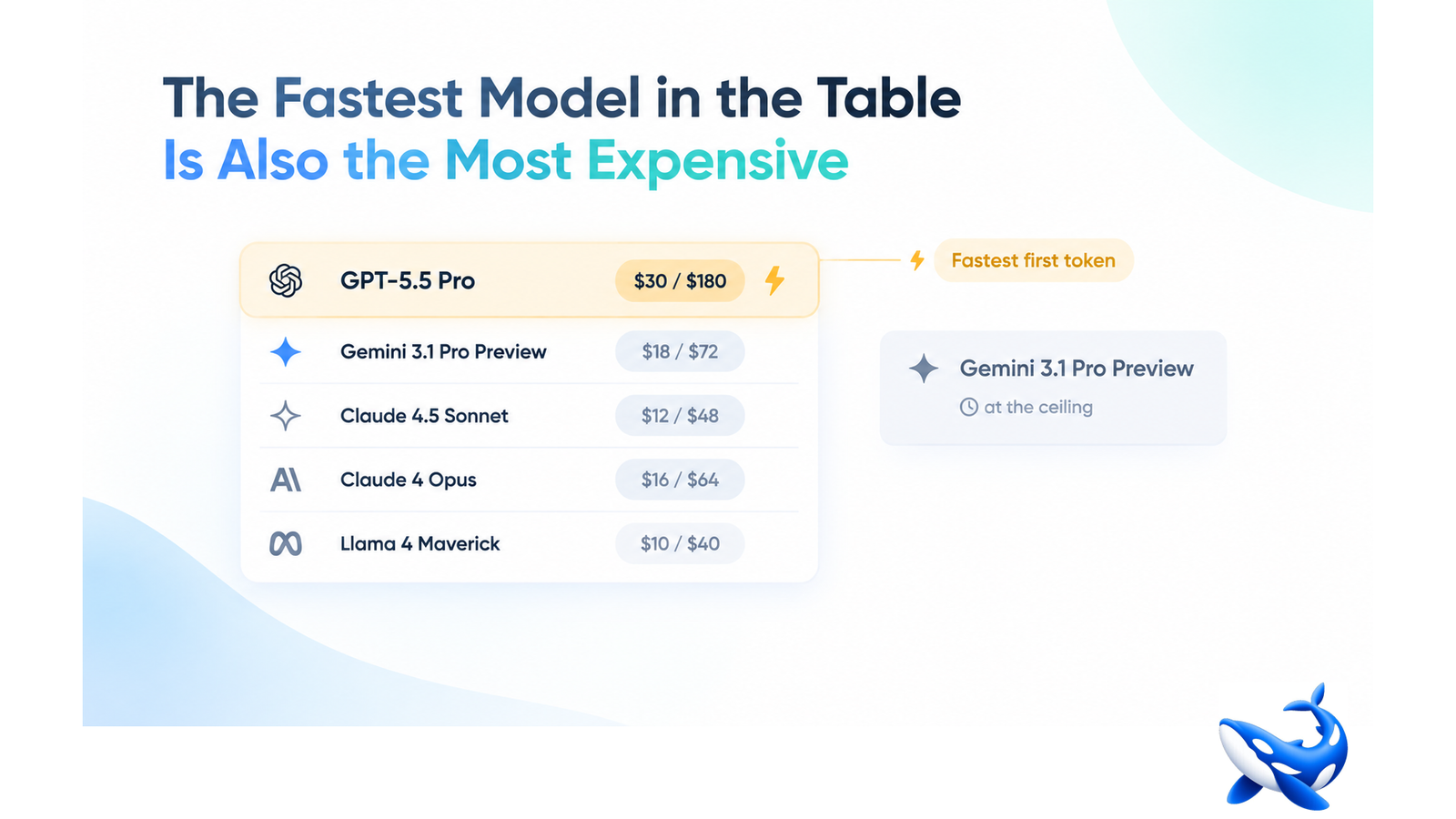
The most expensive row in the table is also the fastest to its first token, and that combination sounds like the oldest marketing trick in the book — but the data comes from a page that shows both columns side by side. On the OrcaRouter comparison page, the dearest model carries a time-to-first-token figure no other row matches, while the premium card sitting right next to it languishes at the measurement ceiling. Open any llm comparison table and you expect price to buy capability; what you do not expect is price buying speed while a cheaper sibling waits at the top of the latency chart.
The correlation you assumed — that the priciest row is a slow, careful one, and the cheap rows are the fast ones — inverts the moment you look at the actual numbers.
The dearest row in the table
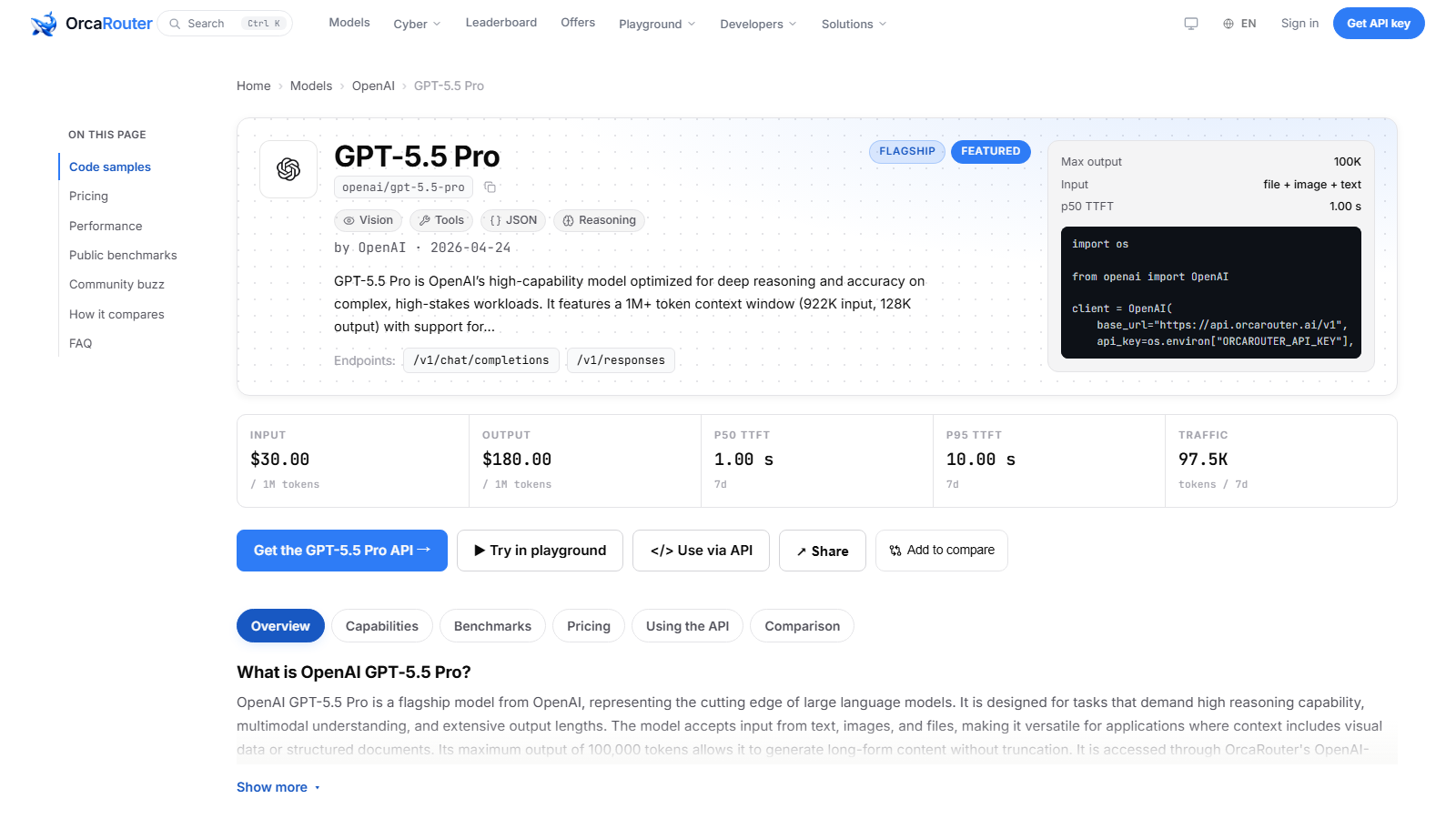
GPT-5.5 Pro is the top of the price column, and by a lot. It costs $30 per million input tokens and $180 per million output — a six-times output multiplier on an already expensive input — which makes it the most expensive model in the entire comparison table. For scale, the same column bottoms out at $0.60 per million input tokens and $2.40 per million output on MiniMax M2.7 highspeed, so the dearest row costs fifty times as much to feed and seventy-five times as much to generate. Its context window is not published, which is itself unusual for a flagship; the row simply does not claim one.
None of that stops it from being the fastest to first token. On the same page, GPT-5.5 Pro posts the quickest time-to-first-token figure in the whole table, faster than any of the eleven rows beneath it. The two facts sit on the same screen, in the same row, and neither one is an error.
The premium row stuck at the ceiling
Now put GPT-5.5 Pro’s speed next to its nearest neighbor in price and the picture gets stranger. Gemini 3.1 Pro Preview costs $2.00 per million input tokens and $12.00 per million output — about one-fifteenth the input price of the dearest row — and it sits pinned at the 10.00 second ceiling on time-to-first-token in our production data. That figure is the measurement ceiling itself, not a genuine latency: the value is the same for nearly every model in the table, because the clock simply stops counting past that mark. A row living at the ceiling tells you it frequently took the full window to begin answering during the measurement period.
GPT-5.4 is the second model sitting at that same 10.00 second ceiling, at $2.50 per million input tokens and $15.00 per million output. So the table offers you a dearest row that starts almost immediately, and two mid-priced rows that spend the full measurement window getting to their first token. If you only ever read the price column, you would assume the exact opposite of what the latency column shows.
What first token actually buys
Time-to-first-token is the delay between sending a request and receiving the first token of the response — the moment the model starts talking back. It is the number that defines whether a model feels instant or feels hung, because everything after the first token is a stream and a stream already in motion is easy to wait for. An interactive assistant, a support widget, a coding agent that sits in an editor — all of them live and die by this first gap.
At $30 per million input tokens, GPT-5.5 Pro is not a row most teams can leave running all day, and nobody is pretending otherwise. But when the latency column shows it starting immediately, it earns its keep in a very specific place: the front door of a product, where the first visible response sets the user’s whole impression. In that spot, speed is not a convenience, it is the feature, and it is worth paying a premium for.
Why the cheap rows are still fast
The reassuring part of the table is that the dearest row does not have a monopoly on speed. DeepSeek V4 Pro posts a 1.76-second p50 time-to-first-token at $0.66 per million input tokens and $1.98 per million output — the cheapest full-sized row in the table and one of the fastest to respond. MiniMax M2.7 highspeed posts a 3.29-second p50 at $0.60 per million input, Grok 4.7 posts a 3.63-second p50 at $2.00 per million input, and Claude Opus 5.5 posts a 3.86-second p50 at $4.00 per million input. The sub-four-second club is crowded with rows priced well below the flagship.
The p50 is the median of the observed delay — half the requests in the window answered at or faster than the figure shown — and a median hides the long tail, which is exactly why the table also carries the 10.00 second ceiling on the slower rows. A p50 of 1.76 seconds on DeepSeek V4 Pro means most requests started fast, but some still took the full window, because the same ceiling governs nearly every row in the table. Treat the p50 as the feel of the model and the ceiling as its worst hour, and you will not be surprised when a “fast” row occasionally waits as long as a “slow” one.
That is the second surprise in the same table: price and first-token latency barely correlate across the twelve rows. The dearest row wins the sprint, but the two cheapest rows are both faster than most of the mid-priced field. If your workload just needs a snappy, affordable responder, the top of the latency chart is not where you have to look, and the bottom of the price column is not the slow place you were warned about.
How to spend the premium
The dearest row is a scalpel, not a default. Use GPT-5.5 Pro where its two advantages overlap: the narrow, high-stakes request that needs the fastest first impression and can absorb a $30 per million input charge. Customer-facing moments, one-shot analytical calls, and demos belong in that bucket. Do not use it where a cheaper row does the same job — and on the latency column, a surprising number of cheap rows do.
The counter-intuitive rule the table teaches is to shop the latency column independently of the price column. Shortlist on the speed you need, then take the cheapest row in that shortlist. If you need a sub-two-second first token, DeepSeek V4 Pro delivers it at $0.66 per million input, which is roughly what most teams actually need. If you need the absolute fastest start and money is not the constraint, the $30 card is the only one that wins that column outright.
The takeaway
GPT-5.5 Pro is the most expensive model in the table at $30 per million input tokens and $180 per million output, and it is also the fastest to its first token — a combination that inverts the usual assumption that price buys careful slowness. Meanwhile Gemini 3.1 Pro Preview at $2.00 and $12.00 and GPT-5.4 at $2.50 and $15.00 both sit pinned at the 10.00 second measurement ceiling, waiting the full window to begin answering.
Speed and price do not line up the way the columns make you expect. The dearest row wins the sprint, the cheapest rows are anything but slow, and the right purchase is the cheapest row that meets your latency budget — with the flagship reserved for the front doors where a fast first token pays for itself.
Sourcing note: all prices, context windows and p50 time-to-first-token figures are OrcaRouter production data from the comparison page and the linked model page, read 2026-10-12. The 10.00 s values are the measurement ceiling, not genuine latencies, and all latency figures are rolling telemetry that will drift. GPT-5.5 Pro’s context window is not published by its vendor. All checked 2026-10-12.
