

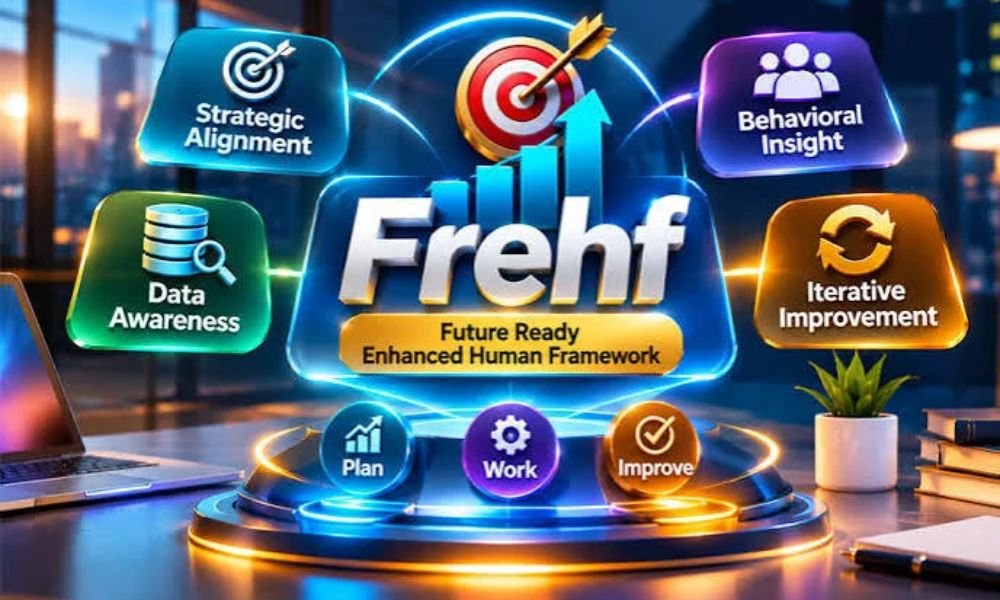
Frehf is an emerging online term associated with business planning, personal productivity, decision-making, and continuous improvement. Although it does not have a universally accepted dictionary meaning, one prominent interpretation describes it as a structured framework designed to help individuals and organizations improve performance. Its ideas overlap with established approaches such as continuous improvement, which focuses on making regular adjustments to processes and results.
Several websites describe Frehf as a human-centered system that combines clear goals, useful data, human behavior, and ongoing adaptation. Some also expand the name as “Future Ready Enhanced Human Framework,” although this full form has not been independently established as official.
An earlier version of Frehf.org presented four connected principles: Strategic Alignment, Data Awareness, Behavioral Insight, and Iterative Improvement.
These principles can be useful when planning projects, managing teams, or improving personal routines. However, the framework’s original creator, academic status, and independent effectiveness remain unverified.
This article explains what Frehf means, how its reported framework works, its practical applications, and the important differences between documented information and online claims.
Frehf Quick Facts
| Detail | Information |
|---|---|
| Name | Frehf |
| Type | Emerging Online Term |
| Common Interpretation | Planning and Improvement Framework |
| Reported Full Form | Future Ready Enhanced Human Framework |
| Official Acronym | Not Independently Confirmed |
| Main Purpose | Clearer Planning and Adaptation |
| First Pillar | Strategic Alignment |
| Second Pillar | Data Awareness |
| Third Pillar | Behavioral Insight |
| Fourth Pillar | Iterative Improvement |
| Associated Website | Frehf.org |
| Website Status | Previously reported as expired |
| Original Founder | Not Verified |
| Academic Recognition | Not Established |
| Main Applications | Business, Productivity, Team Management |
| Software Application | Not Independently Verified |
| Official Certification | Not Established |
| Main Benefit | Structured Thinking and Regular Improvement |
| Evidence Level | Framework Description Exists; Results Unverified |
What Is Frehf?
Frehf is a term used by several websites to describe an approach to organizing decisions, managing work, and adapting to change.
Its most clearly documented framework interpretation comes from the earlier Frehf.org website.
That website described Frehf as a structured approach to clarity, performance, and long-term adaptability.
The proposed framework included four main elements.
These elements focused on goals, information, human behavior, and repeated improvements.
Unlike a conventional software application, Frehf was presented primarily as a method for approaching complex situations.
However, online descriptions differ.
Some writers call it a productivity system. Others describe a business strategy model, human-centered technology philosophy, or digital transformation framework.
Because there is no recognized governing authority establishing one definition, these interpretations should not automatically be combined.
The four-pillar description provides the clearest identifiable starting point.
What Does Frehf Mean?
Frehf is not currently a standard English dictionary word.
Its meaning depends on the context in which someone encounters it.
One recurring expansion is “Future Ready Enhanced Human Framework.”
This interpretation suggests preparing people and organizations for change while keeping human needs central to decisions.
However, the expansion appears mainly in secondary online articles.
No dependable evidence establishes that it was the original meaning chosen by a verified founder.
Is Frehf an Acronym?
Some websites use FREHF as an acronym.
Others write it in lowercase as a brand-style name.
Because these sources disagree, the acronym cannot be treated as officially established.
A reliable acronym normally has an identifiable creator or organization explaining what its letters represent.
For Frehf, that documentation remains incomplete.
Is Frehf a Real Word?
Frehf is a real term in the sense that websites have used it in published material.
However, it does not have one widely recognized definition in ordinary English.
It is more accurate to describe it as an emerging or coined expression.
The Four Pillars of Frehf
The framework formerly described on Frehf.org included four connected principles.
These ideas provide a practical way to understand its intended purpose.
1. Strategic Alignment
Strategic Alignment means making sure that everyday activities support larger goals.
In business, teams sometimes work hard without understanding how their responsibilities contribute to the organization’s priorities.
This can lead to duplicated effort or wasted resources.
Strategic alignment encourages people to identify a clear objective and connect their actions to it.
For example, a company may want to improve customer satisfaction.
Its employees could then focus on faster response times, clearer communication, and resolving common problems.
The main principle is consistency between goals and daily work.
2. Data Awareness
Data Awareness focuses on using relevant information when making decisions.
Businesses collect information through sales reports, customer feedback, website analytics, and financial records.
However, having large amounts of data does not guarantee better decisions.
The important task is identifying useful information and understanding what it means.
For example, an online store might notice that many visitors leave before completing checkout.
Instead of guessing why this happens, the business could review its analytics and customer feedback.
The results may help identify problems requiring attention.
3. Behavioral Insight
Behavioral Insight focuses on understanding how people actually think and act.
Plans can fail when they ignore motivation, habits, communication problems, or resistance to change.
For example, a company might introduce new software.
Even if the software is technically excellent, employees may struggle to adopt it.
Understanding their concerns can help managers provide appropriate training.
The objective is to design processes that consider human behavior rather than assuming everyone will respond identically.
4. Iterative Improvement
Iterative Improvement means making repeated adjustments rather than expecting one perfect solution.
A team begins with a reasonable plan.
It tests the plan and reviews the results.
Then it makes changes based on what it learns.
For example, a website owner might improve page loading speed, review visitor behavior, and make additional adjustments.
Small improvements can accumulate over time.
This principle closely resembles established continuous-improvement methods.
How Does the Frehf Framework Work?
A simple interpretation of Frehf connects the four pillars into a repeating process.
First, an individual or organization identifies an objective.
Second, relevant information is collected.
Third, the needs and behavior of the people involved are considered.
Finally, actions are tested and improved.
A Practical Example
Imagine a small business experiencing declining customer satisfaction.
The owner begins by setting a goal to improve service quality.
Next, customer feedback and support response times are reviewed.
The owner then considers whether employees have appropriate training and resources.
Finally, the company introduces a small change and observes the outcome.
If the change works, it can be expanded.
If it does not, the process can be adjusted.
This is an illustration of how the four reported Frehf principles might be applied. It is not evidence that a proprietary Frehf method produces guaranteed results.
Why Is Frehf Important?
The main attraction of the Frehf concept is its emphasis on structured decision-making.
Modern organizations often face changing customer expectations, new technology, and limited resources.
Without clear priorities, people can spend considerable time on activities that do not support meaningful goals.
A structured process can encourage better coordination.
It can also help teams recognize when existing practices need improvement.
Clearer Goals
A well-defined objective gives people a shared direction.
This makes it easier to evaluate whether everyday tasks are useful.
Better Use of Information
Relevant data can help reduce unnecessary guesswork.
However, data must be accurate and interpreted carefully.
Human-Centered Decisions
Understanding employees, customers, and stakeholders can improve how plans are designed.
Greater Flexibility
Regular reviews allow organizations to respond when circumstances change.
These are potential benefits of established management principles, not independently proven advantages unique to Frehf.
Frehf in Business Management
Businesses can use the ideas associated with Frehf when managing operations.
For example, a company may want to increase efficiency without reducing service quality.
It can begin by identifying its priorities.
Next, it can review existing performance.
Managers can then speak with employees to understand practical challenges.
Finally, the organization can test small improvements.
Improving Customer Service
Customer service teams often handle repetitive questions.
A business might examine which problems occur most frequently.
It could then improve help articles or provide additional training.
The results can be reviewed through customer feedback.
Managing Employees
Team performance depends partly on clear communication.
Employees need to understand their responsibilities and have access to the resources required to complete them.
Behavioral insight can help managers identify obstacles.
Financial Planning
Businesses can also apply similar principles to budgeting.
A company identifies financial objectives, reviews expenses, considers operational needs, and adjusts spending plans when appropriate.
Frehf for Personal Productivity
The principles associated with Frehf can also be adapted to everyday routines.
Someone trying to improve productivity may begin by identifying a few important goals.
Rather than creating an unrealistic schedule, the person can focus on manageable activities.
Progress can then be reviewed regularly.
Setting Priorities
A person may have many responsibilities.
These could include employment, education, family commitments, and personal projects.
Setting priorities helps determine which tasks deserve attention.
Tracking Progress
A notebook, calendar, or spreadsheet can help record completed work.
This makes progress easier to observe.
Understanding Habits
People sometimes struggle with routines because their plans do not fit everyday circumstances.
Considering energy levels, responsibilities, and personal preferences may help create a more realistic schedule.
Making Improvements
If a routine is not working, it can be adjusted.
For example, someone who struggles to study late at night might experiment with an earlier schedule.
The goal is not perfection.
It is steady improvement through observation and practical changes.
Frehf and Digital Transformation
Digital transformation involves using technology to improve how an organization operates.
Businesses may introduce cloud software, automation, analytics, or artificial intelligence.
However, new technology does not automatically solve existing problems.
Successful implementation also depends on clear goals and people.
Strategic Technology Decisions
Organizations should understand why they need a particular tool.
Buying software simply because it is popular may create unnecessary expenses.
Data and Analytics
Digital systems can provide useful information.
However, organizations must distinguish meaningful signals from irrelevant measurements.
Employee Adoption
Workers may require training when new tools are introduced.
Understanding concerns and providing support can improve adoption.
Continuous Evaluation
Technology requirements change.
Regular reviews help determine whether existing systems still meet business needs.
Is Frehf Connected to Artificial Intelligence?
Some articles connect Frehf with artificial intelligence and human-centered technology.
These descriptions suggest that technology should support human decision-making rather than replace thoughtful judgment.
However, no verified artificial intelligence application has been established as the official Frehf product.
The framework’s general ideas can still be applied when evaluating AI tools.
For example, a business considering AI-assisted customer service could establish a clear objective, measure performance, consider customer needs, and review results.
This is an example of practical management, not proof of a specialized Frehf AI technology.
Is Frehf an App or Software Platform?
Several online articles describe Frehf as software.
Some mention dashboards, automation, team collaboration, or AI-assisted recommendations.
However, a functioning official software application with independently verified features, pricing, and ownership has not been established.
Users should be cautious about claims describing specific product capabilities.
Does Frehf Have a Login?
No authenticated official Frehf application login has been independently confirmed.
Is Frehf Free?
There is no verified universal pricing structure for a Frehf product.
Is There a Mobile App?
No independently authenticated official Frehf mobile application has been established.
Can Businesses Subscribe to Frehf?
No verified commercial subscription service has been confirmed.
These limitations do not make the framework’s underlying ideas useless. They simply mean that readers should distinguish a conceptual model from a functioning software product.
What Happened to Frehf.org?
Frehf.org is one of the most identifiable websites associated with the term.
Its earlier indexed content described a structured framework using four pillars.
The site presented itself as research-informed and tested in practical settings.
However, those claims were not accompanied by clearly verifiable independent studies.
A later website review published in October 2026 reported that Frehf.org had displayed a domain-expiration notice.
This means historical search results should not automatically be treated as proof that a current service remains active.
The domain’s live condition may change, but its former descriptions remain relevant to understanding how Frehf was presented online.
Is Frehf Scientifically Proven?
There is no independently verified body of research establishing Frehf itself as a scientifically validated framework.
Its individual principles are related to established fields.
Strategic alignment is widely discussed in management research.
Data-based decision-making is an established business practice.
Behavioral insight is studied in psychology and behavioral economics.
Continuous improvement has a long history in operations management.
However, combining familiar concepts under a new name does not automatically create a scientifically validated method.
Claims about specific productivity gains or faster employee training would require transparent studies and reliable measurements.
Frehf vs. Traditional Planning
The online Frehf model resembles several existing management approaches.
| Feature | Traditional Planning | Reported Frehf Framework |
|---|---|---|
| Goal Setting | Yes | Strategic Alignment |
| Performance Measurement | Often | Data Awareness |
| Human Behavior | Varies | Behavioral Insight |
| Regular Improvements | Depends on Method | Iterative Improvement |
| Academic Recognition | Many Established Methods | Not Independently Established |
| Official Certification | Depends on Method | Not Verified |
The comparison shows that Frehf’s four ideas are familiar, even if the name itself is new.
Frehf vs. Agile
Agile is an established approach to managing work through adaptability, collaboration, and repeated delivery.
It is commonly associated with software development.
Frehf’s reported principles also emphasize adaptation and improvement.
However, Agile has documented frameworks, publications, training programmes, and widespread professional adoption.
Frehf does not have the same verified institutional history.
Therefore, the two should not be treated as equivalent standards.
Frehf vs. Kaizen
Kaizen is a Japanese concept commonly associated with continuous improvement.
It encourages regular efforts to improve processes and performance.
The iterative-improvement pillar of Frehf resembles this idea.
However, Kaizen has a documented historical background in Japanese management and manufacturing.
Frehf’s original development remains much less clear.
Frehf in Education
Educational institutions can use similar principles when organizing teaching and learning.
Teachers may set clear learning objectives.
Student performance can then be reviewed through appropriate assessments.
Educators can consider individual learning needs and adapt teaching methods.
Finally, lessons can be improved based on feedback.
Student Planning
Students can apply these ideas when preparing for examinations.
A realistic study goal provides direction.
Practice tests offer performance information.
Understanding individual learning habits can help improve schedules.
Regular revision supports gradual progress.
Again, this is a practical application of familiar educational principles rather than a verified proprietary Frehf curriculum.
Frehf and Team Collaboration
Teams often struggle when responsibilities are unclear.
Communication problems can lead to duplicated work or missed deadlines.
A structured approach can help members understand shared goals.
Clear Responsibilities
Each person should know what they are responsible for delivering.
Shared Measurements
Teams can agree on useful indicators of progress.
Understanding Team Behavior
Managers can consider differences in communication styles and working preferences.
Regular Reviews
Short meetings and performance reviews help identify problems before they become more serious.
These habits can support collaboration regardless of the framework name.
Benefits of the Frehf Approach
The reported framework offers a useful way to organize familiar management ideas.
Better Decision-Making
Combining goals with relevant information can help people make more informed choices.
Improved Organization
Clear priorities reduce confusion about what should happen next.
Greater Adaptability
Regular evaluation encourages adjustments when circumstances change.
Stronger Communication
Considering human behavior can help teams understand obstacles and expectations.
Consistent Improvement
Small changes can be evaluated before larger commitments are made.
However, these benefits are general possibilities.
They should not be presented as scientifically demonstrated outcomes unique to Frehf.
Limitations and Challenges of Frehf
The framework also has important limitations.
Unclear Ownership
A verified founder or governing organization has not been established.
Inconsistent Definitions
Different websites describe Frehf in different ways.
Limited Independent Evidence
There is no clearly identified independent study demonstrating the framework’s effectiveness.
No Confirmed Certification
A recognized training or certification system has not been established.
Risk of Overcomplication
Adding unnecessary terminology to familiar planning methods can create confusion.
Unverified Software Claims
Some articles describe software features without providing working documentation.
Readers should therefore focus on practical usefulness and avoid accepting promotional claims without evidence.
How to Apply Frehf in Everyday Work
Someone interested in the four-pillar model can experiment with it without purchasing software.
Begin by writing down one specific objective.
For example, a small business may want to improve the percentage of website visitors who complete purchases.
Next, collect relevant information.
This might include visitor behavior, checkout completion rates, and customer feedback.
Then consider behavioral factors.
Customers may abandon checkout because forms are confusing or information is missing.
Finally, make one manageable improvement.
Review the results and decide whether further changes are necessary.
The process can continue as the business learns more.
This example demonstrates a reasonable planning exercise rather than a guaranteed outcome of the Frehf framework.
Why Is Frehf Trending Online?
The term has appeared across numerous websites discussing technology, productivity, business, and online culture.
Its unusual spelling makes readers curious.
Different definitions also encourage additional searches.
Some articles describe Frehf as a management framework, while others call it a brand, slang expression, or software platform.
This inconsistency creates confusion.
However, the number of published articles does not prove that Frehf has become a widely adopted professional method.
Independent evidence would be necessary to establish actual adoption or popularity.
Interesting Facts About Frehf
- Frehf does not have one established dictionary definition.
- It appears in several different online contexts.
- One common expansion is Future Ready Enhanced Human Framework.
- The expansion has not been independently verified as official.
- Frehf.org previously described a four-pillar framework.
- Strategic Alignment was its first pillar.
- Data Awareness was the second pillar.
- Behavioral Insight was the third pillar.
- Iterative Improvement completed the model.
- These principles overlap with established management methods.
- No verified founder has been identified.
- No recognized universal Frehf certification is established.
- Some websites describe Frehf as software.
- An official functioning app has not been independently confirmed.
- Some articles associate Frehf with artificial intelligence.
- The framework’s specific effectiveness has not been independently demonstrated.
- Frehf.org was previously reported to have an expired domain.
- The term appears in business and technology publications.
- Its four principles can be illustrated through ordinary planning activities.
- Readers should distinguish established management ideas from unverified claims about the Frehf brand.
Frequently Asked Questions About Frehf
1. What is Frehf?
Frehf is an emerging online term most clearly associated with a four-pillar planning and improvement framework.
2. What does Frehf mean?
Its exact meaning is not universally established. Some websites describe it as a structured approach to planning and adaptability.
3. What does FREHF stand for?
Some articles expand it as Future Ready Enhanced Human Framework, but this has not been independently confirmed as the official full form.
4. Is Frehf a real word?
It is used online but is not widely recognized as a standard English dictionary word.
5. Is Frehf a framework?
An earlier version of Frehf.org described it as a structured framework.
6. What are the four pillars of Frehf?
Strategic Alignment, Data Awareness, Behavioral Insight, and Iterative Improvement.
7. Who created Frehf?
No independently verified original founder has been identified.
8. Is Frehf connected to business?
Yes. Its reported principles can be applied to business planning and performance management.
9. Is Frehf an AI tool?
No official AI product using the name has been independently verified.
10. Does Frehf have an app?
A functioning official app has not been reliably established.
11. Is Frehf free?
There is no confirmed universal pricing model or subscription service.
12. What is Frehf.org?
It is a domain formerly associated with the four-pillar framework.
13. Is Frehf.org still active?
An October 2026 report described the domain as expired. Its current live status should be checked directly.
14. Is Frehf scientifically proven?
No independent research has established the overall framework as scientifically validated.
15. Is Frehf similar to Agile?
Both emphasize adaptation, but Agile is an established professional approach with a clearer documented history.
16. Is Frehf the same as Kaizen?
No. Its iterative-improvement principle resembles Kaizen, but the frameworks are not identical.
17. Can students use Frehf?
Students can apply the reported principles to goal setting, study planning, and progress reviews.
18. Can small businesses use Frehf?
Yes. The ideas can be adapted to ordinary planning and management activities.
19. Does Frehf improve productivity?
Its principles may support organized work, but specific effectiveness claims have not been independently established.
20. Does Frehf require special software?
No. The four general principles can be applied using ordinary planning tools.
21. Is Frehf a certified management standard?
No recognized certification or standard has been independently established.
22. Why is Frehf appearing on websites?
The unusual term has attracted explanatory articles describing different meanings and possible applications.
23. Is Frehf a slang word?
Some websites suggest slang-related interpretations, but no widely established slang definition has been verified.
24. What is the biggest advantage of Frehf?
Its most useful interpretation is bringing goals, data, people, and ongoing improvement into one planning discussion.
25. What is the biggest limitation of Frehf?
Its unclear origin and lack of independent evidence make it difficult to assess claims made specifically about the framework.
Final Thoughts
Frehf is an emerging online term associated with planning, productivity, decision-making, and adaptability.
Its most identifiable framework interpretation comes from an earlier version of Frehf.org, which described four principles: Strategic Alignment, Data Awareness, Behavioral Insight, and Iterative Improvement.
These ideas are useful in many practical situations.
Clear goals help people understand what they want to achieve. Relevant data supports informed decisions. Behavioral insight encourages consideration of human needs, while regular improvements allow plans to change over time.
However, Frehf should not be presented as a scientifically validated or universally recognized management system.
Its original creator remains unverified, and many claims about software, artificial intelligence features, and measurable performance improvements lack independent support.
For readers interested in the concept, the most practical approach is to understand the four principles and compare them with established management methods.
Ultimately, Frehf is best viewed as an informal framework description whose usefulness depends on how its familiar ideas are applied.
For more technology guides, business insights, online trends, and informative articles, visit Carter Magazine.
Meta Description: Discover Frehf meaning, its four pillars, business uses, productivity benefits, framework examples, Frehf.org history, and verified facts in 2026.
