

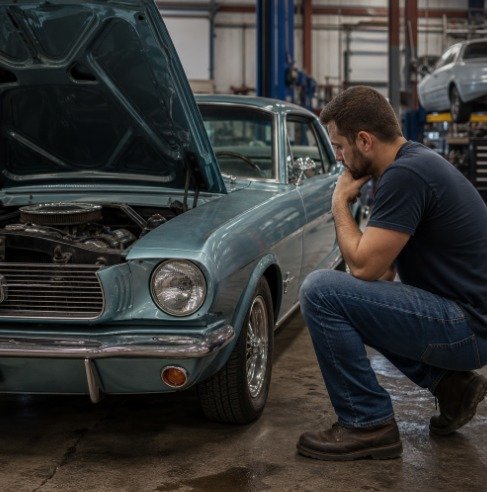
Most people who buy a classic Mustang do it twice. The first time they buy the car they saw in a photograph: sharp paint, correct wheels, a shutline that looks right on a phone screen. The second time, usually two or three years later, they buy the car they actually wanted — the one that starts on a cold morning, tracks straight on a motorway slip road and doesn’t need a weekend of fiddling before every outing. The gap between those two purchases is where most of the money goes, and it is almost entirely avoidable.
This is a guide to closing that gap. It assumes you like the idea of a first-generation Mustang — or a Camaro, a Challenger, a Chevelle — and that you want to drive it rather than photograph it. The principles hold across the whole 1960s American performance category, but the Mustang is the useful example because there are more of them, more parts for them, and more ways to get one wrong.
The three cars hiding behind the same bodyshell
Classified listings flatten everything into one category. In practice, a 1965–70 Mustang arrives in one of three conditions, and they are completely different ownership propositions.
The survivor
Original paint, original interior, original everything, with the patina to prove it. These cars are increasingly prized and increasingly expensive, because originality can only be removed, never added. The trade-off is that a survivor drives exactly like a 1967 car: vague steering, drum brakes that need planning, a cabin that gets loud above 60. That’s not a fault. It’s the point. But you need to want it.
The old restoration
This is the dangerous one, and it’s the bulk of the market. A car restored in the late 1990s or 2000s has had fifteen to twenty-five years to settle, and settling reveals shortcuts. Filler cracks over seams. Rubber hardens. Fresh paint over unrepaired rust buys perhaps a decade before it blisters at the lower rear quarters and the cowl. The car looks finished, which makes it hard to price honestly, and the owner genuinely believes it is finished because it was when they bought it.
The rebuilt car
Stripped to bare metal, reassembled with new or re-manufactured components, often with discreet modern upgrades underneath. Costs the most up front and depreciates least in the first five years of your ownership, because there’s nothing left to discover. The purist objection is real — you are no longer looking at a 1968 car in any meaningful sense — but the usability gain is enormous.
The word “restoration” is doing a lot of work
It helps to remember that the whole idea of restoring a car is relatively modern. For most of the twentieth century a used performance car was just a cheap used car, maintained to keep it running and modified to make it faster — there’s a good piece arguing that people in period didn’t really restore old cars at all, they simply used them until they stopped being useful. That history matters when you’re inspecting a car, because it explains why so many 1960s Mustangs carry evidence of three or four different eras of work: a 1974 repaint, a 1983 engine swap, a 1998 interior, a 2015 set of wheels. There is no single original condition to return to, only a set of decisions somebody made.
So when a seller says “fully restored”, the only useful follow-up is: restored by whom, in what year, to what standard, and what paperwork survives? A folder of invoices with dates and part numbers is worth more than any description. No folder usually means no restoration you can verify.
An inspection order that actually finds problems
Look at the structure before you look at the car. In that order:
- Get it off the ground. Torque boxes, frame rails, floor pans, the front of the rear wheel arches. Unibody Mustangs carry their strength in these areas and repairs here are the expensive kind.
- Cowl and screen surround. Water sits in the cowl vent, rots it from inside, then wets the footwells. A damp carpet on a dry day tells you more than a compression test.
- Shut the doors. Twice. A door that needs a lift to latch is a sagging hinge at best and a tired shell at worst.
- Panel gaps across the nose and down the flanks. Factory tolerances were generous, but they were consistent. Inconsistency means accident repair.
- Numbers last. VIN, door tag, casting dates. Matching numbers affect value; they tell you nothing about whether the car is safe.
Drive it properly if you can. Thirty minutes minimum, including something resembling a motorway. Heat is the great revealer: cooling systems, fuel percolation, brake fade and electrical gremlins all wait until the car is hot. A ten-minute trundle around an industrial estate proves only that the battery is charged. And take a fabric magnet, not a magnet on a chain — a thin cloth over a strong magnet lets you probe filler depth without scratching paint, which sellers appreciate.
Where the fantasy cars sit
Every buyer has a halo spec in mind, and in Mustang circles that usually means the big-block and Boss cars. Genuine examples trade in a rarefied world of registries, documentation and six-figure correction work, which is why the market for high-quality recreations and reimagined builds has grown so much — cars that take a correct bodyshell and build it to a known specification with modern engineering underneath. If you want the look and sound of a 1969 Boss Mustang without inheriting fifty-year-old brakes, wiring and sealing, that route is worth understanding before you commit to hunting an original. The honest trade-off is clear: you give up provenance, and you gain a car you can take across a country in a day. Which side of that line you prefer is a question about how you intend to use the car, not about authenticity as a virtue in itself.
Living with one
Budget for the first year separately from the purchase. Fluids, belts, hoses, brake flexibles, a fuel filter, a proper set of tyres with a recent date code — none of it is glamorous and all of it is cheaper than the failure it prevents. Fit a battery cut-off if the car sleeps for weeks at a time, and keep a small trickle charger on it.
Then there’s the noise question. A 1960s V8 with a decent exhaust is tiring over three hours on a dual carriageway, and the factory radio is not going to help. Plenty of owners now keep the original head unit in place for authenticity and simply bring their own audio, which is why discussions about which wireless earbuds are worth the money under £200 come up surprisingly often among classic drivers planning long runs — passenger use, co-driver comms on a rally, or podcasts on the motorway slog home from a show. It is a small thing, but it is the kind of small thing that turns a car you admire into a car you actually take out.
Buy the condition, not the spec sheet
The best advice in this corner of the hobby hasn’t changed in decades: a plain-spec car in excellent condition will give you more pleasure and cost you less than a rare car in poor condition. Rarity is a resale argument. Condition is an ownership argument. Decide which of those you’re buying, pay for inspection before you pay for the car, and be prepared to walk away from something you’ve already told your friends about. The cars are not scarce. Good ones are.
