

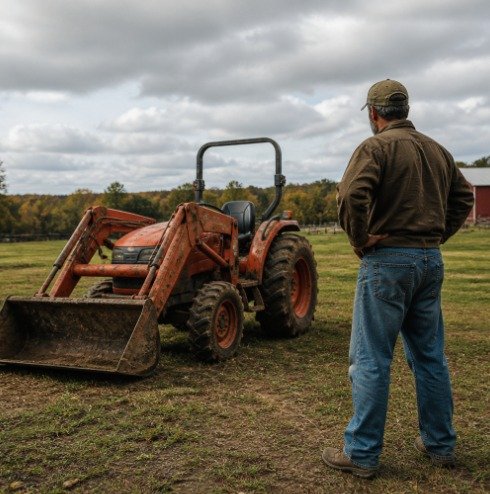
Most people buy a tractor twice. The first one is chosen on price and gut feeling, and within two seasons it is either straining at the loader or too heavy to be useful on soft paddocks. The second one is chosen on measurements — hitch category, hydraulic flow, wheelbase, tyre choice — and it tends to stay for twenty years. The difference between those two purchases is not budget. It is an afternoon spent working out what the land actually demands.
This guide walks through the sizing logic, the implement package that makes a tractor earn its keep, the parts decision that quietly determines resale value, and a seasonal service rhythm that keeps a mower deck and a baler out of the workshop in July.
Start with the heaviest job, not the average one
A tractor spends most of its life doing light work: shifting a trailer, topping a field, scraping a yard. None of that tells you what to buy. Sizing is dictated by the single heaviest task you will repeat. If that task is lifting round bales onto a stack, the loader lift capacity at full height — not at pin height — is your governing number. If it is running a 6-foot rotary cutter through overgrown pasture, you need PTO horsepower with headroom, roughly 5 horsepower per foot of cutting width as a working rule, plus more on slopes and in heavy growth.
Three categories cover most rural property owners:
- Sub-compact (roughly 15–25 HP): mowing, light grading, small loader work on an acre or three. Gentle on turf, limited on implements, usually Category 1 limited hitch.
- Compact (roughly 25–45 HP): the sweet spot for 5 to 40 acres. Full Category 1 three-point hitch, real loader capacity, enough weight to pull a box blade or a small disc harrow.
- Utility (roughly 45–75 HP and up): hay work, larger tillage, round balers, heavy loader cycles. Heavier on soft ground and bigger in gateways, so measure your tightest turn before you commit.
Two specifications get overlooked. The first is hydraulic flow in gallons per minute, which decides whether a grapple or a post-hole auger feels brisk or sluggish. The second is weight — a light tractor with a loaded bucket loses rear traction and becomes a seesaw, which is why ballast boxes and loaded rear tyres exist. A useful comparison of models and the trade-offs behind them appears in Grit’s rundown of compact tractor options for small farms, which is worth reading alongside your own field measurements rather than instead of them.
Build the implement package before you sign for the tractor
A bare tractor is a very expensive way to sit outdoors. Dealers increasingly sell pre-built or custom packages precisely because matching implements at the point of purchase avoids the classic mismatch: a 3-foot tiller behind a tractor with 5 feet of track width, leaving two untilled stripes on every pass.
The core four
- Front loader with a quick-attach plate. Non-negotiable. Quick-attach lets you add a grapple, pallet forks or a bale spear later without welding.
- Rotary cutter or finish mower. Rotary cutter for rough ground and brush; finish mower for paddocks and amenity grass you actually want to look tidy.
- Box blade or land plane. The implement that pays for itself on tracks and gateways, especially after a wet winter.
- Ballast. A ballast box or rear weight. It costs little and protects the front axle while improving braking with a loaded bucket.
Match widths to the tractor, not the catalogue
Implement width should slightly exceed the tractor’s outside tyre width so you are not driving over unworked ground. Check hitch category, PTO speed (540 versus 1,000 RPM) and whether you need a top-link adjustment to level the implement. If hay is in your plans, confirm PTO horsepower and hydraulic requirements for the mower conditioner, tedder, rake and baler as a system — a baler that technically runs on your tractor but leaves nothing in reserve will cost you in clutch wear.
Where a local dealer changes the arithmetic
The specification sheet tells you what a machine can do; a dealer’s parts counter and service bay tell you how long it will keep doing it. Buying through an authorised dealership means the people configuring your package know which loader pairs with which frame, and it means genuine parts and trained repair work are a drive away rather than a shipping estimate. For readers farming or managing acreage in Kentucky, Tennessee or Indiana, H&R Agri-Power is an example of that model in practice — an authorised Kubota dealer handling new and used tractors and implements, pre-built and custom tractor packages, genuine Kubota parts alongside general tractor, mower and baler parts, and equipment repair at its locations, including lawn mower repair at Owensboro. Working with a dealership that stocks both the machine and its service history is what turns a breakdown in haying season from a lost crop into a lost afternoon.
Genuine parts: when it matters and when it doesn’t
Not every component justifies the premium, but some clearly do. Use genuine parts for anything that affects tolerances, fuel delivery or emissions compliance: injectors, filters on modern common-rail diesels, hydraulic seals, engine gaskets and electronic sensors. A fuel filter with the wrong micron rating is a cheap part that can write off an expensive pump.
Wear items with simple geometry — mower blades, shear bolts, PTO shields, baler twine guides, tines — are more forgiving, provided the steel grade and dimensions match. Keep the receipts either way. A complete service file with dated parts invoices consistently adds more at resale than a fresh coat of paint ever will.
A seasonal service checklist that actually gets followed
Spring, before first cut
- Change engine oil and filter; inspect air filter rather than blowing it out with a compressor.
- Grease every zerk on loader, three-point and PTO shafts — count them so none is missed.
- Check hydraulic hoses for chafing at pinch points and top up to the sight glass.
- Sharpen and balance mower blades; replace rather than grind anything cracked or thinned.
- Set tyre pressures front and rear; mismatched pressures scuff turf and upset 4WD drivelines.
Mid-season, during hay and mowing
- Blow radiator screens and cooler fins daily in dusty conditions.
- Check baler belt or roller tension and chain lubrication before each run, not after.
- Re-torque wheel nuts after heavy loader work.
- Carry spare shear bolts, twine, a hose or two and the correct grease gun in the truck.
Autumn and winter layup
- Fill the fuel tank to limit condensation and treat the diesel if it will sit.
- Drain and replace hydraulic and transmission fluid on schedule, not on feel.
- Disconnect or trickle-charge the battery; clean and protect terminals.
- Store implements off bare soil, cylinders retracted, cutting edges greased.
- Book service work now — workshops are quiet in January and overwhelmed in June.
Think about the whole holding, not just the machine
Equipment decisions shape land use more than most owners expect. A narrower tractor lets you keep hedgerows and rough margins instead of widening gateways; a finish mower and a tedder let you manage grass as a crop rather than a chore. Those margins are also where diversified income tends to appear, whether that is forage sales, agritourism or the kind of pollinator-friendly enterprise described in a guide to keeping bees while turning a profit. The tractor that fits your land gives you the time and the uncut edges to try things like that.
The decision in five lines
Measure your tightest gateway and your steepest slope. Identify the heaviest repeated job and size the loader and PTO to it, with headroom. Buy the implements as a matched package. Spend on genuine parts where tolerances matter and keep the paperwork. Then put the seasonal checklist somewhere you will see it — on the workshop wall, not in a drawer — because the machine that lasts is almost always the one that was serviced on a dull Tuesday rather than rescued on a busy Saturday.
