

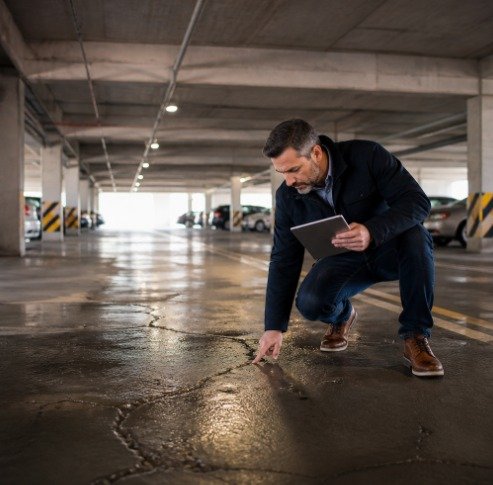
Asphalt rarely collapses all at once. It fails in a sequence that is almost boringly predictable: a hairline crack opens, water gets in, the subgrade softens, traffic flexes the weakened section, and within a few seasons you have a pothole that costs many times what the original crack would have cost to seal. Anyone who manages a retail centre, office park, apartment community or school campus is effectively managing that sequence — whether or not they know it.
The clearest place to watch this play out is a climate with aggressive freeze-thaw cycling, high UV exposure and winter de-icing. Colorado is a textbook case, and the pavement management habits that have evolved there travel well to any owner trying to stretch a capital budget over a 20-year asset.
The physics behind the damage
Asphalt is a flexible pavement: a bound surface riding on compacted base and subgrade. Its strength comes from the binder holding the aggregate together, and from the base staying dry and stable. Two things attack that system.
The first is oxidation. Sunlight and air stiffen the binder, so the surface loses flexibility, greys out and begins to ravel — you see loose stone collecting at the kerb line and along drive aisles. The second is water. Once a crack lets water into the base, every freeze cycle expands that water and jacks the pavement apart from below. At high elevation, a single shoulder season can deliver dozens of freeze-thaw transitions, which is why cracks that looked cosmetic in October can be structural by April.
The reason failure starts at the perimeter is simple: edges and joints are unconfined. Kerb lines, pavement-to-concrete joints, drainage swales and the seams around catch basins are where water concentrates and where compaction was always hardest to achieve. Walk any ten-year-old car park and the worst square metres will be within two metres of an edge, a drain or a bin enclosure.
The maintenance hierarchy, cheapest to most expensive
Treatments are not interchangeable. Each one addresses a specific defect, and applying the wrong one is the most common way owners waste money.
- Sweeping and drainage correction. Unglamorous and the best value in the stack. Standing water and silt-choked drains accelerate every other failure mode.
- Hot-pour crack sealing. A flexible, rubberised material routed and poured into working cracks so they can move without admitting water. This is the single highest-return treatment on a sound pavement.
- Sealcoating. A surface coating that restores colour and slows oxidation. It is a wearing course, not a structural repair — it will not bridge a crack or fix a soft spot.
- Pothole repair and full-depth patching. Required where the base has failed. Surface-only patches over a wet base are temporary by definition.
- Mill-and-overlay or full reconstruction. The capital event. Milling removes the fatigued surface so the new lift bonds properly and the finished grade still drains.
Sequence matters as much as selection. Patch and crack seal first, sealcoat second, stripe last — and allow proper cure time between steps rather than compressing them to suit a tenant’s trading calendar.
Condition ratings instead of guesswork
Serious contractors and public agencies score pavement using a Pavement Condition Index — a 0 to 100 rating built from observed distresses, their severity and their extent. The value for an owner is not the number itself but what it enables: segmenting a site so the healthy sections receive preventive treatment while the failed sections are queued for reconstruction. That is how you avoid the two classic errors, which are sealcoating a pavement that needs rebuilding and rebuilding one that only needed crack sealing.
A condition survey is done on foot, section by section, and a mid-sized site takes a couple of hours. Managers who do their own interim walks tend to build a simple kit — a measuring wheel, a phone camera and a decent pair of earbuds for dictating voice notes while keeping hands free, which is one of the more defensible uses for the kind of hardware reviewed in our rundown of the best wireless earbuds under $200. Photograph the same reference points each visit and the rate of deterioration becomes visible rather than anecdotal.
Budgeting without a price list
Commercial pricing varies too much by region, mobilisation distance, square footage, access constraints and material cost to generalise honestly. What you can do is understand the structure of a bid. Ask how crack-seal quantities were measured, whether patching is quoted as full-depth or surface, what sealer dilution and application rate are proposed, how many coats, and who is responsible for traffic control and tenant notice. Residential figures are not transferable to a commercial site, though published breakdowns of driveway sealing costs are a useful primer on why coverage rates and material type drive the number more than labour does.
On the planning side, treat pavement the way you treat roofing: a multi-year schedule with phased areas, so one asset does not produce a single ruinous line item in one fiscal year. Phasing also keeps a site trading, which matters more to retail and healthcare tenants than any other variable.
Striping, ADA markings and the compliance layer
Markings are the cheapest part of the job and the one most likely to create liability. Faded fire lanes, under-width accessible stalls, missing access aisles and worn directional arrows all attract complaints and, in the case of accessibility, regulatory exposure. Any resurfacing project is the right moment to correct stall dimensions, add van-accessible aisles and bring ramps and detectable warnings into line, because the layout is being redrawn anyway. Re-striping an existing layout without reviewing compliance simply re-certifies an old mistake in fresh paint.
Choosing a contractor who plans rather than sells
The useful filter is whether a bidder leads with an assessment or a product. A contractor who walks the site, scores it, explains which sections should be left alone this year and puts the work in a sequence is doing pavement management; one who quotes a sealcoat over everything is selling a day’s work. Colorado owners weighing that distinction often look at long-established specialists in commercial asphalt paving Colorado such as Asphalt Coatings Company, which has worked across the state since 1986 using in-house crews, CDOT approved sealant materials and PCI-based assessments to build condition-based, multi-year plans for retail centres, HOAs, office parks and municipal properties from Fort Collins and Denver to Colorado Springs and Grand Junction. Licensed and insured, and with a 4.7/5 Google rating, the firm’s estimators reply within one business day — but the broader point for any owner is to insist on that assessment-first approach regardless of who holds the contract.
A workable annual rhythm
- Late winter: walk the site after thaw, log new cracking and base failures, photograph reference points.
- Spring: clear drains, sweep, schedule patching and crack sealing before the surface heats up.
- Summer: sealcoat and stripe in warm, dry weather with adequate cure windows; phase by zone to keep access open.
- Autumn: seal any cracks that opened over the season and confirm nothing will pond over winter.
- Every three to five years: commission a formal condition survey and refresh the capital plan.
Pavement rewards owners who are early and punishes those who are reactive. Water is the enemy, edges are the weak point, and a sealed crack is the cheapest repair you will ever authorise. Everything else in a maintenance programme is an argument about how long you waited.
